Welcome, Missions Explorer

You're in the right place.
Whether'r you're a recent grad figuring out what's next, sensing a call to missions, or jut curious reaching the unreached, this place is for you.

Start Exploring

Essential Missions Foundations

In Matthew 28:19, Jesus said, "Therefore go and make disciples of all nations..." That word "nations" translates from the Greek ethnē, meaning every distinct people group.

Today, thousands of these groups still haven't heard. Here, you'll find practical resources and clear pathways from prayer to action.

No pressure. Just honest next steps toward the nations.

Frontier People Groups

Frontier People Groups represent the most isolated and least-reached communities on earth. These are groups with less than 0.1% evangelical Christian presence—essentially no local church or witness among them.

Current numbers: 3,200 groups, representing 1.9 Billion people. What makes them different? They have no access to the gospel in their own language and culture, requiring cross-cultural missionaries to bring the message.

Learn More →

Unreached People Groups

An Unreached People Group (UPG) is defined by two thresholds: less than 2% evangelical Christian presence, or less than 5% Christian adherents (including all Christian traditions).

Current numbers: 4,482 groups, representing 3.5 Billion people. These groups lack sufficient local resources to evangelize their own people without outside assistance.

Learn More →

The 10/40 Window

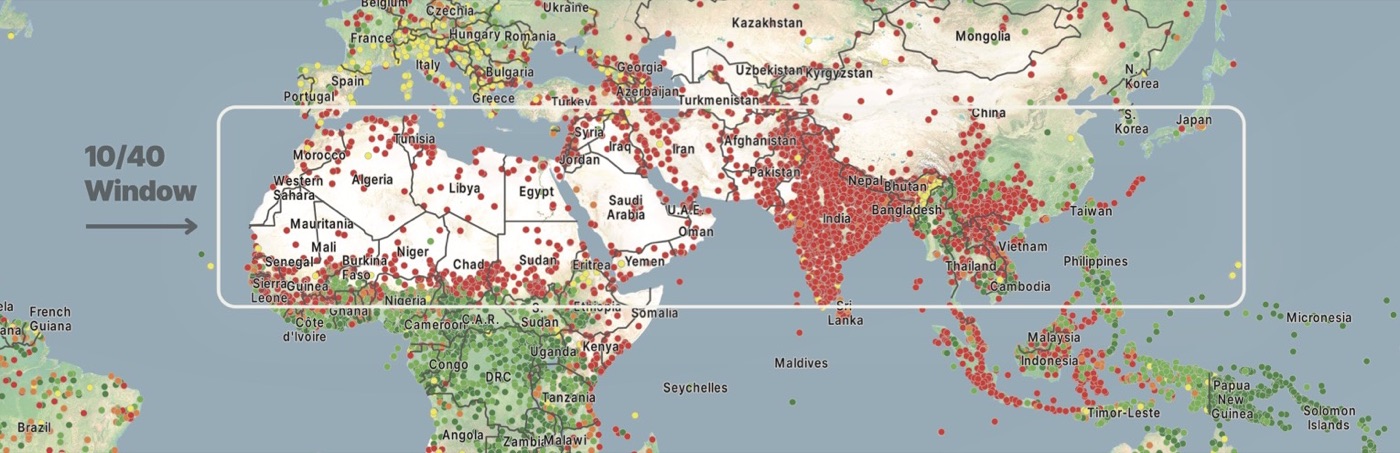
The 10/40 Window is a geographic region between 10 and 40 degrees north latitude, stretching from West Africa to East Asia. This area contains the highest concentration of unreached people groups and the world's least-evangelized nations.

Why it matters: Two-thirds of the world's population lives here, yet it receives less than 2% of global missions resources. Understanding this region helps prioritize prayer and strategic engagement.

Learn More →

Progress Scale & PGAC/PGIC

The Progress Scale measures evangelization progress from 0 (no known Christians) to 5 (movement to Christ). PGAC (People Groups Across Countries) counts groups once globally, while PGIC (People Groups In Countries) counts groups once for each country.

Why both? Different counting methodologies help us understand both cultural relationships and distinct ethnic boundaries—both matter for effective mission strategy.

Learn More →

Unreached of the Day

Every day, Joshua Project highlights one unreached people group for focused prayer. This daily feature helps believers develop a habit of intercession for specific communities.

Available through our website and mobile app, "Unreached of the Day" provides prayer points, cultural insights, and ways to engage. Download our app to receive daily notifications and build your missions awareness.

Learn More →

Joshua Project History

Since 1995, Joshua Project has been researching and cataloging the world's unreached people groups. What started as a research initiative has become the most comprehensive database of its kind.

Our mission: To identify and highlight the ethnic people groups with the fewest followers of Jesus, equipping the global church to engage strategically. We're not a sending agency—we're a research and mobilization resource.

Learn More →

Hover over each card to learn more

Get Daily Prayer Reminders

Download the Unreached of the Day app and receive daily profiles of unreached people groups, prayer points, and cultural insights.

Download App

Navigate Our Data Tools

Joshua Project's database is vast—over 10,404 people groups, hundreds of countries, and countless data points. Here's how to navigate it effectively and find what you're looking for.

Dashboard

Start here for the big picture. The Dashboard provides global statistics, regional breakdowns, and key metrics at a glance. Perfect for understanding the scope of the unreached challenge and tracking progress over time.

Explore Dashboard →

Lists

Pre-filtered collections save time. Browse lists like "Largest Unreached Groups," "Unreached in the 10/40 Window," or "Groups with No Known Christians." These curated lists help you focus on specific priorities.

View Lists →

Countries

Drill down geographically. Select any country to see all people groups within its borders, understand religious demographics, and identify strategic entry points. Great for planning trips or focusing your research.

Browse Countries →

Interactive Map

Visual spatial exploration. The map shows people group locations, concentrations, and relationships. Zoom in to see smaller details or zoom out for regional patterns. Ideal for visual learners and strategic planning.

Open Interactive Map →

Pro Tip

Start with the Dashboard to get oriented, then use Countries or Lists to narrow your focus. The Interactive Map is perfect for understanding geographic relationships. Most users find this sequence most effective: Dashboard → Lists → Countries → Map.

Missions 101 Email Course

Ready to go deeper? We offer two free email courses designed to build your missions foundation. These courses are delivered via email over several weeks, with digestible lessons that fit into your schedule.

Missions 101a: Foundations covers the basics—what are unreached people groups, why they matter, and how the global church is responding.
Missions 101b: Strategic Engagement goes further, exploring practical pathways from prayer to action, including short-term trips, long-term service, and digital evangelism.

Select Course(s):

Learn about Strategic Regions

Want to stay updated on specific regions? Subscribe to receive weekly email updates featuring people group profiles, testimonies from the field, security updates for sensitive areas, and focused prayer points. Choose one or more regions that align with your interests or calling.

Select Region(s):

Digital Evangelism: A New Frontier

The internet has broken down barriers that once seemed insurmountable. Today, 5.5 billion people are online, including millions in closed countries where traditional missionaries cannot go. Digital evangelism isn't a replacement for incarnational ministry—it's a powerful complement and, in some contexts, the only viable pathway.

Why Digital Matters

With 5.5 billion people online globally, digital platforms offer unprecedented reach. In closed countries where physical access is restricted, the internet provides a window for first gospel encounters. Many unreached people are now hearing about Jesus for the first time through direct messages, social media, and online content.

Methods & Platforms

Effective digital evangelism includes WhatsApp discipleship groups, YouTube channels in local languages, online Bible studies via video calls, and Christian influencers sharing testimonies. The key is meeting people where they already are—on platforms they use daily for communication and entertainment.

Cultural Considerations

Cultural intelligence still matters online. Honor-shame dynamics, relationship-building protocols, and language proficiency remain critical. Digital doesn't mean impersonal—it means culturally appropriate engagement through technology. Understanding local communication styles and religious sensitivities is essential.

Organizations That Send Workers to the Unreached

These reputable organizations have been sending workers to the unreached for many years. They are a great resource for those interested in serving the unreached. Click on the logos to learn more about each organization.

Becoming a Missionary

You've moved from curiosity to conviction. You're not just exploring anymore—you're seriously considering how God might use you in global missions. This section addresses practical questions about pathways, timelines, and preparation.

Assess Your Season

Missions isn't just for recent college graduates. People serve at every life stage—empty nesters, career changers, retirees, and yes, young adults. Your season isn't a barrier; it's a parameter that helps determine the right type of service. Consider your family situation, financial capacity, health, and skills when exploring options.

Types of Service

Short-term (2 weeks - 2 years): Vision trips, summer projects, gap year programs. These experiences help you explore, learn, and contribute while testing your calling.

Mid-term (2-5 years): Language learning, internships, specialized projects. Deeper commitment with defined endpoints.

Long-term (5+ years): Full-time church planting, leadership development, specialized ministry. Career-level commitment to a people group or region.

Training & Preparation

Effective missionaries require preparation: cross-cultural training, biblical foundations, language acquisition, specialized skills (medical, education, business, etc.), and psychological evaluation. Most sending agencies provide training programs, but self-directed learning in these areas strengthens your readiness and demonstrates commitment.