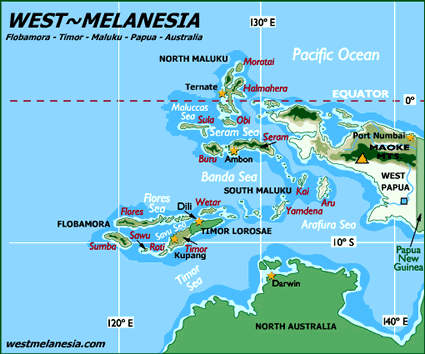
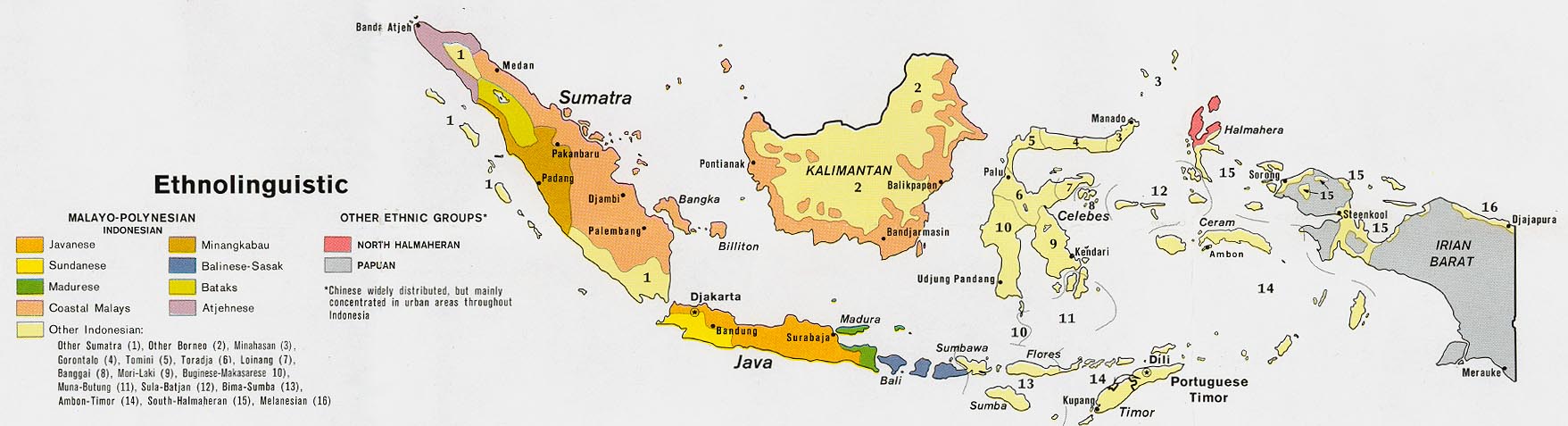
The Tobelo, also known as the coastal Tobelo or O'Hoberera Manyawa ("people who live outside the forest"), are a non-Austronesian ethnic group indigenous to the northern peninsula of Halmahera Island in North Maluku Province, Indonesia, primarily residing in coastal villages along the eastern shores of North Halmahera Regency, including the town of Tobelo, which serves as the regency capital.
Their name derives from the Tobelo language, a West Papuan isolate with dialects like Gamsungi, Dodinga, and Boeng, spoken alongside Indonesian and Ternate Malay in daily interactions. As part of the northern Halmahera peoples, the Tobelo trace origins to ancient Papuan migrations from New Guinea around 40,000 years ago, settling the volcanic lowlands and mangrove coasts to form socio-territorial domains bound by kinship, landscape, and ancestry, distinct from their forest-dwelling relatives, the Togutil (O'Hongana Manyawa or "forest people").
Pre-colonial society blended settled coastal farming with trade in spices, sago, and fish, governed by loose alliances and animistic pacts invoking ancestral spirits for harmony amid inter-village raids and headhunting. The 16th century introduced Ternate Sultanate suzerainty, integrating Tobelo into Islamic spice networks while preserving adat (customary law); Dutch VOC traders arrived in the 17th century, exploiting clove groves and fostering hybrid economies, followed by 19th-century Protestant missions that accelerated Christianization among coastal groups. The Hibua Lamo pact—an ancient covenant promoting coexistence between Muslims and Christians—emerged as a cornerstone of social resilience. Post-1949 independence, Tobelo navigated Indonesian integration amid transmigration and resource booms, but the 1999-2001 Maluku sectarian violence devastated communities, displacing over 100,000 and prompting adat revival through the Hibualamo Adat Council to mediate reconciliation.
Today, they embody North Maluku's cultural mosaic, with Tobelo town formalized as the regency capital in 2004, balancing modernization with traditions tied to the island's biodiversity.
The Tobelo embrace a coastal rhythm in stilted bamboo villages fringed by mangroves and volcanic shores on Halmahera, with tidal ebbs and monsoon harvests. Work centers on swidden agriculture of rice, maize, cassava, and bananas on terraced lowlands, supplemented by fishing in reef shallows for tuna and prawns using outrigger canoes, while men harvest sago palms and cloves for market barter in Tobelo or Ternate, and women process fish into dried strips or tend vegetable plots. Many commute to nickel mines or eco-tourism havens for wages.
Family dynamics follow patrilineal and bilateral kinship in extended households clustered around sacred squares, where elders convene hearth councils to arbitrate via gestured chants. Aunts share guardianship of children.
Marriages seal alliances through multi-day feasts and bride service. Celebrations are highlighted by weddings featuring Cakalele warrior dances before the bride, gong-orchestrated processions, and feasting under starlit canopies to honor marital unions.
The annual North Halmahera Cultural Festival showcases full ceremonial dress with bamboo light arches at Christmas and Easter garden competitions, while New Year gatherings draw music troupes for dances and songs. Funerals blend Christian vigils with ancestral floats to guide souls.
Food staples include sago porridge swirled with fish broth and greens—paired with ikan bakar (grilled seafood slathered in turmeric sambal), roasted cassava leaves, and ritual pork or eel adob.
About half of the Tobelos adhere to Protestant Christianity, a Reformed tradition integrated through 19th-century Dutch and American missionary outreach that reshaped animistic foundations into emphases on communal salvation, ethical harmony, and divine guardianship over sea and soil. Elders fuse biblical narratives with ancestral motifs, viewing mangrove spirits as metaphors for providence, while churches serve as hubs for moral deliberation and aid, with subtle shamanic echoes lingering in harvest blessings for fertility and safe voyages.
Formal recognition of customary lands through participatory mapping and legal titling would safeguard mangrove fisheries and sago groves from illegal logging and mining encroachments. Community-driven education programs incorporating Tobelo dialects and oral histories would combat linguistic erosion.
Pray for enriched Tobelo-language Scripture to spark vibrant fellowships.
Pray for Tobelo Christians to have such devotion to Christ that they turn away from the spirit world.
Pray for Tobelos to reach out to their Muslim neighbors in love, sharing the only Savior.
Pray for fortified mangrove buffers against erosion and overfishing, yielding resilient harvests for communal larders.
Pray for youth apprenticeships in eco-crafts and digital archiving, fortifying cultural bonds amid Ternate's pull.
Scripture Prayers for the Tobelo in Indonesia.
PeopleGroups.org. "Tobelo of Indonesia." https://www.peoplegroups.org/explore/GroupDetails.aspx?peid=22724
Wikipedia. "Tobelo people."
https://en.wikipedia.org/wiki/Tobelo_people
Wikipedia. "Tobelo."
https://en.wikipedia.org/wiki/Tobelo
eHRAF World Cultures. "Tobelo - Description." https://ehrafworldcultures.yale.edu/cultures/oh18/description
ResearchGate. "Reconciliation and Revitalization: The Resurgence of Tradition in Postconflict Tobelo, North Maluku, Eastern Indonesia." https://www.researchgate.net/publication/231971819_Reconciliation_and_Revitalization_The_Resurgence_of_Tradition_in_Postconflict_Tobelo_North_Maluku_Eastern_Indonesia
Mongabay. "In eastern Indonesia, a forest tribe pushes back against miners and loggers." https://news.mongabay.com/2018/03/in-eastern-indonesia-a-forest-tribe-pushes-back-against-miners-and-loggers/
Project Multatuli. "'They Have Nothing Now': North Maluku Forest Dwellers Cornered by Expanding Nickel Mines."
https://projectmultatuli.org/en/they-have-nothing-now-north-maluku-forest-dwellers-cornered-by-expanding-nickel-mines/
ResearchGate. "The practice of local wisdom of Tobelo Dalma (Togutil) Tribal community in forest conservation in Halmahera, Indonesia." https://www.researchgate.net/publication/284565398_The_practice_of_local_wisdom_of_Tobelo_Dalma_Togutil_Tribal_community_in_forest_conservation_in_Halmahera_Indonesia
EveryCulture.com. "Tobelorese."
https://www.everyculture.com/East-Southeast-Asia/Tobelorese.html
| Profile Source: Joshua Project |