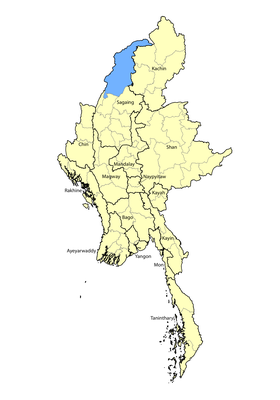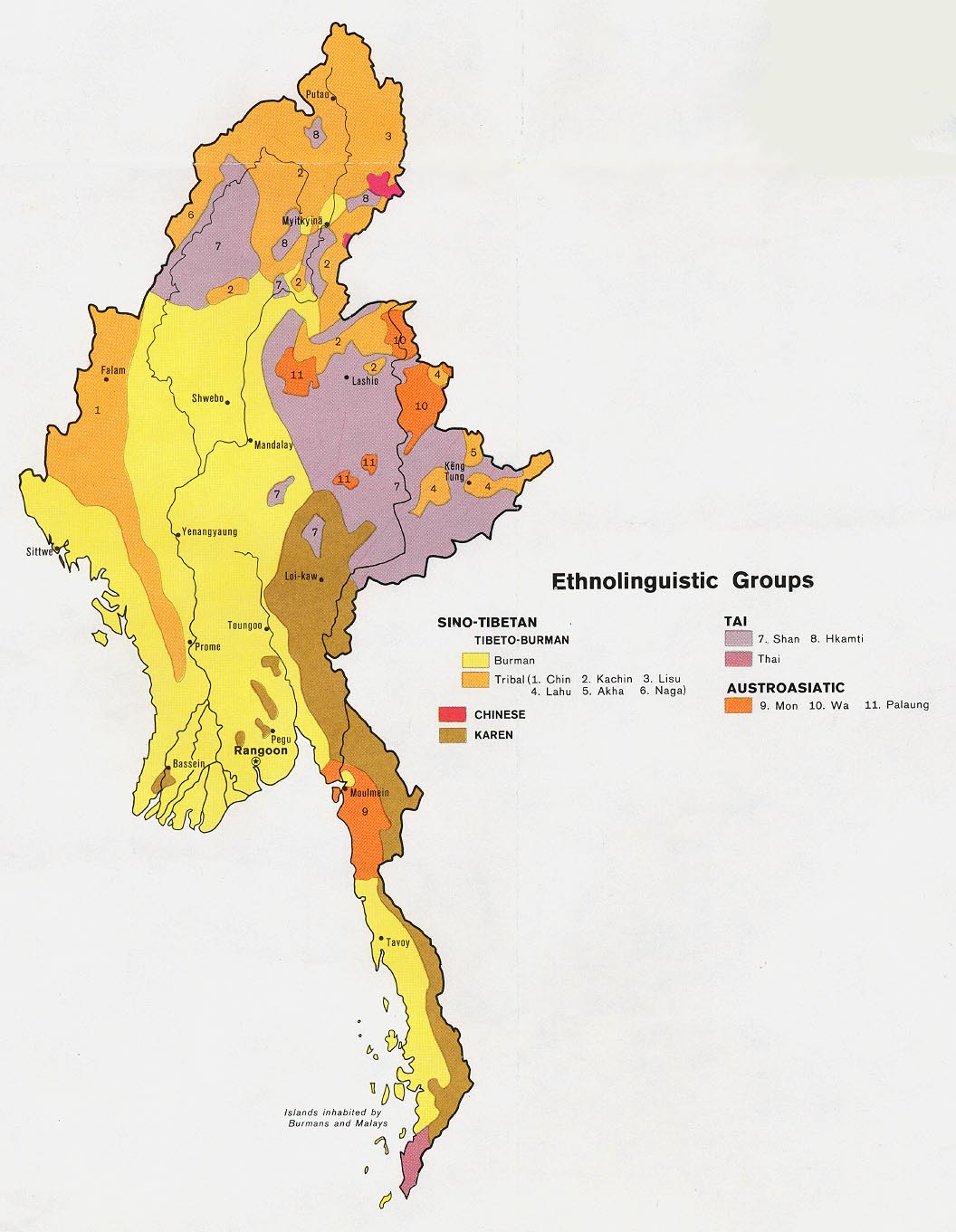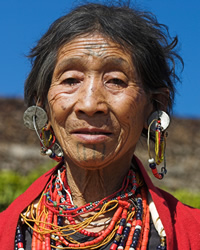

The Paungnyuan Nagas inhabit 13 villages within Lahe and Hkamti townships near the border between western Myanmar's Sagaing Region and India. Lahe, which contains families from at least nine different Naga tribes, is "rugged and rocky with deep valleys and swift streams. Due to the mountainous terrain, transportation and communication are a challenge."
This tribe is often called Makyam or Macham, after one of their primary villages, but their ethnic and language name is Paungnyuan, which means "village leaders." Because they live to the east of the Lainong Naga, many outsiders assume they are a subgroup of Lainong, but their languages are markedly different despite their cultural similarities. In fact, some Paungnyuan families moved away from the Lainong and formed their own communities because the language barrier between the two groups led to misunderstandings.
Their language is spoken by all members of the tribe, and while many of the older generation can speak Lainong Naga as a second language, young people today prefer to learn Burmese as it is more useful to their careers. Lexical studies reveal that Paungnyuan is not closely related to any other Naga language. It shares only 31% similarity with Ponyo-Gongwang Naga, 29% with Lainong, and 27% with Lao Naga.
History: The mountains where the Paungnyuan make their home used to be verdant and full of wildlife, but generations of slash-and-burn agriculture has left the terrain barren. The people "cultivate two to three years in an area and then move to another place. They leave the soil for about ten years and when it is again ready for cultivation, they come back to the previous fields to plant. They live this way all year round."
Because accessing water is often difficult in the mountains, the Paungnyuan struggle to grow food, although beans, corn, yams, rice, and maize are produced in the Lahe area. One visitor remarked that "the men enjoy hunting and fishing, while the women collect edible leaves and cultivate the fields." In some areas, Paungnyuan men reportedly wear "black cloths bordered with white lines and covered with lines of red rectangles."
Before many Paungnyuan families converted to Christianity in the 1980s, they were spirit-appeasing animists who lived in fear of vengeful demons. Their valuable animals were sacrificed to the spirits, which kept many people trapped in poverty. A major annual festival called kwe pwe was held where "each village would sacrifice what they could afford. In one festival held at Hkalai, six mithun, four buffalo, ten cows, and eight pigs were offered up…with a priest offering a prayer to the spirits for a good and bountiful harvest."
Although there are a small number of Buddhists and animists among them today, most Paungnyuan people are professing Christians who attend Baptist or Church of Christ fellowships. Although an orthography based on the Roman script was developed in 2016, no part of the Bible has yet been translated into Paungnyuan. Believers use the Burmese Bible and songbooks, although many struggle to understand the words. Other church activities, including the preaching, praying, and announcements, are done in the Paungnyuan tongue.
What sets them apart is their limited exposure to outside influences. Compared to more accessible groups in Myanmar, the Paungnyuan Naga have had fewer opportunities for education, infrastructure development, and consistent contact with Christian teaching. As a result, they remain one of the less-reached Naga subgroups, with many still holding to traditional beliefs and practices. Paungnyuan Christians need God's Word in their own language, and to allow it to deeply penetrate their hearts.
Pray for the Holy Spirit to send revival fire to Paungnyuan families and churches.
Pray that soon they will have the devotion to Christ it takes to risk their lives for the sake of the gospel.
Pray that soon they will be making disciples of Buddhists, leading them to the only Savior.
Pray for their physical needs to be met in such a way others know they are blessed by God.
Scripture Prayers for the Naga, Paungnyuan in Myanmar (Burma).
Asia Harvest
1 SIL, "The Makyan Naga of Myanmar," Unpublished report, 2007.
2 Naga Survey Team, Sociolinguistic Survey of Makyam and Southern Tangshang Varieties in Lahe Township and Dunghi Sub-Township, Myanmar (unpublished report, 2012), p. viii.
3 Summer Institute of Linguistics, Ethnologue: Languages of the World (27th edition, 2024), online version.
4 SIL, "The Makyan Naga of Myanmar."
5 SIL, "The Makyan Naga of Myanmar."
6 J. D. Saul, The Naga of Burma: Their Festivals, Customs, and Way of Life (Bangkok: Orchid Press, 2005), p. 51.
7 Saul, The Naga of Burma, p. 176.
| Profile Source: Joshua Project |
| Other PDF Profile |