Curripaco in United States
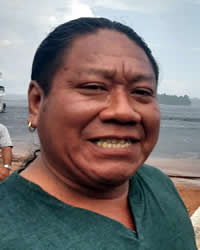
Photo Source:
Noemia Kazue Ishikawa - Wikimedia
Creative Commons
|
Send Joshua Project a map of this people group.
|

| People Name: | Curripaco |
| Country: | United States |
| 10/40 Window: | No |
| Population: | 300 |
| World Population: | 21,100 |
| Primary Language: | Curripaco |
| Primary Religion: | Christianity |
| Christian Adherents: | 65.00 % |
| Evangelicals: | 13.00 % |
| Scripture: | New Testament |
| Ministry Resources: | Yes |
| Jesus Film: | Yes |
| Audio Recordings: | Yes |
| People Cluster: | Amazon |
| Affinity Bloc: | Latin-Caribbean Americans |
| Progress Level: |

|
Introduction / History
The Curripaco speak Kurripako (Curripaco), a member of the Arawakan language family. The language is considered vulnerable—still used in many communities, with literature and standardized forms emerging, yet under pressure from dominant national languages. Historically, the Curripaco (also identified with the larger Wakuenai / Baniwa–Curripaco grouping) have lived along river basins in the Amazon region. Their livelihoods traditionally centered on shifting agriculture, hunting, fishing, and gathering in the rainforest environment. Because their homeland spans national boundaries, many communities are fragmented or dispersed. Most live in the south American countries of Venezuela, Brazil, and Colombia. A small number now live in the United States.
What Are Their Lives Like?
In their traditional homeland, Curripaco communities live in villages along rivers and tributaries, often accessible only by water. Their daily subsistence includes cultivating manioc (cassava) and other crops, fishing in rivers and streams, hunting forest animals, and gathering wild plants. Villages typically maintain strong clan and kinship structures, with shared responsibilities for food, housing, and ritual obligations. Crafts such as basketry and other handiwork are important both for everyday use and as small sources of trade.
In recent times, some communities face pressures from mining, deforestation, illegal extraction, and national development that encroach on their land and resources. Those Curripaco who have moved to the U.S. live in urban or mission-related settings; their lives often involve navigating foreign languages and cultures, preserving identity in diaspora.
What Are Their Beliefs?
Traditionally, Curripaco spirituality is rooted in animism, ancestral spirits, and a cosmic worldview where humans, animals, plants, and spirits exist in interconnection. Shamans (ritual specialists) mediate between humans and the spirit world, using sacred songs, chants, hallucinogenic plants, and ritual knowledge to heal, interpret visions, and guide communal ceremonies. Their mythology includes deities such as a Transformer / Creator / Trickster, an ancestral son-spirit who imparts knowledge, and spirits of water, earth, and air (for example, an Anaconda Lord of Waters) among a host of lesser spirits. Sacred myths often recount cycles of creation, destruction, renewal, and the heroic actions of ancestors.
With the arrival of evangelistic missionaries (particularly Protestant and Pentecostal missions in the 20th century), many Curripaco communities adopted Christian beliefs. In some villages, the community structure was reshaped by missionary influence: often the missionary pastor becomes a local "captain" or community authority in place of traditional roles. Many Curripaco Christians now practice a blended faith, where church attendance, Christian teaching, and biblical stories coexist with respect for ancestral traditions, ceremonial rhythms, and spiritual cosmology.
What Are Their Needs?
Remote Curripaco communities face significant challenges in areas such as healthcare, clean water, education, and basic infrastructure, while those living in diaspora settings—such as in the United States—struggle with cultural adaptation, language acquisition, and preserving their identity. Yet beneath these practical needs lies a deeper spiritual longing. Though many identify as Christian, few have experienced intentional discipleship or access to Scripture and resources in their own language. There is a pressing need for indigenous Christian leaders who can minister from within the Curripaco worldview, offering gospel-centered teaching that is both theologically grounded and culturally meaningful. In addition, the community continues to carry the weight of historical and spiritual trauma caused by displacement, marginalization, and external pressures. What they need is not just programs, but a relational, respectful Christian presence—one that embodies humility, fosters healing, and walks alongside them in the work of reconciliation and restoration. Addressing their spiritual needs means more than evangelism; it requires holistic discipleship, culturally sensitive ministry, and the cultivation of trust through long-term, incarnational presence.
Prayer Points
Pray for the complete Bible to be faithfully translated into the Curripaco language.
Pray for more discipleship and evangelistic resources to be translated and made readily available in their heart language.
Pray for the grace and hope of Christ to fill the hearts of Curripaco believers that are scattered far from their homeland.
Pray for a clear-cut separation between Curripaco traditional religion and biblical Christianity in the hearts of the Curripaco people.
Pray for indigenous Christian leaders who understand the Curripaco culture and traditions and can faithfully communicate how Jesus is better.