Amazigh, Menasser in Algeria
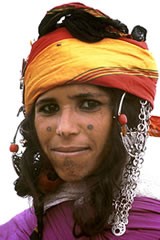
Photo Source:
Anonymous
|
Send Joshua Project a map of this people group.
|
| People Name: | Amazigh, Menasser |
| Country: | Algeria |
| 10/40 Window: | Yes |
| Population: | 90,000 |
| World Population: | 90,000 |
| Primary Language: | Chenoua |
| Primary Religion: | Islam |
| Christian Adherents: | 0.00 % |
| Evangelicals: | 0.00 % |
| Scripture: | Translation Needed |
| Ministry Resources: | No |
| Jesus Film: | No |
| Audio Recordings: | No |
| People Cluster: | Amazigh-Shilha |
| Affinity Bloc: | Arab World |
| Progress Level: |

|
Introduction / History
The Imazighen, better known as Berbers, are the indigenous people of North Africa. The singular term for Imazighen is Amazigh. They are a strong and proud people. The very name Imazighen is often translated to mean "free or noble men." They prefer that term, so that is what we will use.
Their tribes stretch from the Siwa Oasis in Egypt to the Atlantic Ocean. Most likely they once inhabited the entire North African territory, forcing the black population to move further southward through the desert. However, the exact origins of these tribes and how they arrived in North Africa remains a mystery. Some believe they have been there since prehistoric days while others disagree.
The name "Berber" is derived from the Latin word barbari, meaning "barbarians." This term was used by the Romans in the third century A.D. to describe the "people of the Maghrib." (The Maghrib refers to the regions of North Africa that were conquered by Muslims between 670 and 700 A.D. It included Morocco, Algeria, Tunisia, and the western portion of Libya.).
Although the Maghrib has been, for the most part, "Arabized" by language and Islamic culture over the centuries, there are still groups of Imazighen, like the nine Saharan Imazighen tribes, who have retained much of their original Imazighen traditions and characteristics. Although Imazighen languages differ greatly from one another in sound, they only vary slightly in grammar and vocabulary. The Menasser Imazighen speak Central Atlas Tamazight among themselves, but Algerian Arabic in the marketplace.
What Are Their Lives Like?
Since the Sahara Desert is a harsh environment, most of the Saharan tribes occupy several oases. While there are many similarities between the various Imazighen groups, their lifestyles and quality of life vary according to the region in which they live.
The Menasser Imazighen economy rests on a fine balance between farming and raising cattle. Every tribe, without exception, depends heavily on domestic animals for carrying heavy loads, milk and dairy products, meat, and hides or wool. No Imazighen tribe depends on farming for survival. Hunting rarely adds to the food supply. The Menasser Imazighen are often noted for their skills in various crafts. Domestic tasks such as weaving and pottery are the main work of the women. The men specialize in woodworking, metalworking, and, more surprisingly, fine needlework. Regarding labor, the men do most of the farming, while the women are responsible for milking and gathering.
Menasser Imazighen societies can be broken down into three basic units: the community, the district, and the tribe. The community is a political collection of clans; the district is a cluster of communities; and the tribe is a group of districts that are characterized by a common territory, name, and culture. Government at the community level is notably democratic. All authority is vested in an assembly called the jemaa. The jemaa, composed of all adult males, usually meets weekly.
In nearly every Imazighen society, each district, and sometimes each community as well, is divided into two opposing factions called sofs. Membership into the sof is hereditary. Among tribes that no longer live in their original environments, the political units are allied with one another in identical divisions of higher levels known as lefs. Bonds of alliance are re-confirmed by traditional forms of hospitality as well as by huge annual feasts to which members invite one another. If warfare occurs, it is almost exclusively between districts of the opposite lef. However, since lefs are primarily defensive rather than offensive alliances, their primary purpose is to preserve peace in a region.
What Are Their Beliefs?
Almost all Menasser Imazighen are Muslims. However, most are only nominally Muslim. Their observances of Islamic law are generally lax. For example, the concept of baraka, or holiness, is highly developed among them. Menasser Imazighen believe that many people are endowed with baraka, of which the holiest are the shurifa, or the direct descendants of Mohammed. This came from pre-Islamic beliefs.
In view of the general acceptance of Islam, it is particularly interesting that almost all Menasser Imazighen prefer monogamous marriages. In the few tribes where polygamy does exist, it is practiced only by the few wealthy men.
What Are Their Needs?
These Saharan tribes have few Christian resources available to them. Because it is difficult to reach them geographically, they must be the focus of individual church planting efforts.
The quality of life for Menasser Imazighen is poor. The need for community development projects may provide open doors through which missionaries may enter.
The North African national governments remain closed to traditional missionary efforts, and politicized Muslim groups are outspoken against Christianity. We need to pray that God breaks through!
Prayer Points
Pray that God will raise up faithful intercessors who will stand in the gap for Menasser Imazighen.
Ask the Lord to call people who are willing to go to North Africa and share Christ with Menasser Imazighen.
Pray that God will raise up loving African Christians to reach out to their Muslim neighbors.
Ask God to strengthen, encourage, and protect the small number of Imazighen Christians who are scattered throughout North Africa.
Ask the Holy Spirit to soften the hearts of the Menasser Imazighen towards Christ and his claims of being the only way to the Father.
Ask the Lord for Menasser Imazighen fellowships that will plant more fellowships among other Imazighen tribes.