Korama unspecified in India
Photo Source:
Anonymous
|
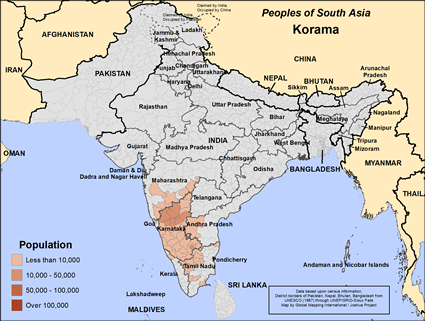
Map Source:
People Group data: Omid. Map geography: UNESCO / GMI. Map Design: Joshua Project
|
| People Name: | Korama unspecified |
| Country: | India |
| 10/40 Window: | Yes |
| Population: | 231,000 |
| World Population: | 231,000 |
| Primary Language: | Kannada |
| Primary Religion: | Hinduism |
| Christian Adherents: | 0.00 % |
| Evangelicals: | 0.00 % |
| Scripture: | Complete Bible |
| Ministry Resources: | Yes |
| Jesus Film: | Yes |
| Audio Recordings: | Yes |
| People Cluster: | South Asia Dalit - other |
| Affinity Bloc: | South Asian Peoples |
| Progress Level: |

|
Introduction / History
Korama is one of the ancient nomadic communities of India, spread across the Deccan and South India under various regional names. Many Korama communities have traditions of origin connecting them with the Kuru kingdom and the Kauravas of the Hindu epic Mahabharata. According to this tradition, and as recorded in historical accounts, the Kauravas who survived the battle of Kurukshetra fled southwards and took refuge in the hill tracts of Central India. This entry traces their traditions of origin, historic livelihoods as salt and grain traders, fortune tellers, and bamboo craftsmen, their historical associations with the Kadambas and Vijayanagara, and the grave injustices they experienced under the colonial Criminal Tribes Act.
Korama, also known as Korama Setty, comes from the root kuru, which means "fortune telling," a reference to their traditional occupation. In a tribe where cross-cousin and uncle-niece marriages are allowed, their very name, Korama, suggests mystery.
After the Kurukshetra war, (approximately 1700) the survivors of the Kauravas became scattered across the Deccan and South India, with some groups taking refuge in forests, mountains and valleys. Over time, different groups are said to have adopted different occupations. Some became fortune tellers, salt and grain traders, hunters, forest-dwelling communities who hunted pigs, thieves, bamboo craftsmen, musicians known as Bhajantris, snake jugglers and bird catchers, while some were engaged in pig rearing.
They live in Bangalore and speak Kannada. Some of their population has spilled into other southern Indian states.
What Are Their Lives Like?
After the Kurukshetra war, survivors of the Kauravas became scattered across the Deccan and South India, with some groups taking refuge in forests, mountains and valleys. Over time, different groups adopted different occupations. Some became fortune tellers, salt and grain traders, hunters, forest-dwelling communities who hunted pigs, thieves, bamboo craftsmen, musicians known as Bhajantris, snake jugglers, bird catchers, and pig rearing.
They are endogamous, meaning they prefer marriages to take place within their group; cross cousin marriages are common.
Boys are educated and girls to a lesser degree. The literacy level however is on the low side so the gospel may need to be given in oral form.
What Are Their Beliefs?
The Korama combine Hindu religious identity with animistic beliefs and practices, relying on their own priests and maintaining traditional spiritual customs connected with folk religion and fortune-telling.
What Are Their Needs?
The Korama people need to experience the abundant life offered only by Jesus Christ. They need faithful Christian workers, intercessors, and spiritually mature believers who can help foster a church-planting movement among their community.
Prayer Points
Pray that Indian believers will help lead the Korama into a church planting movement.
Pray for spiritual openness that will lead to many putting their faith in Christ.
Pray for faithful workers and intercessors.