Hmong Njua in Myanmar (Burma)
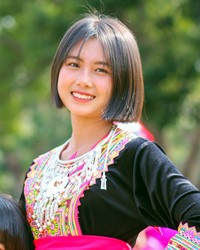
Photo Source:
Copyrighted © 2026
AlivePhoto - Shutterstock All rights reserved. Used with permission |
Send Joshua Project a map of this people group.
|
| People Name: | Hmong Njua |
| Country: | Myanmar (Burma) |
| 10/40 Window: | Yes |
| Population: | 12,000 |
| World Population: | 800,800 |
| Primary Language: | Hmong Njua |
| Primary Religion: | Ethnic Religions |
| Christian Adherents: | 10.00 % |
| Evangelicals: | 5.00 % |
| Scripture: | Complete Bible |
| Ministry Resources: | Yes |
| Jesus Film: | No |
| Audio Recordings: | Yes |
| People Cluster: | Miao / Hmong |
| Affinity Bloc: | Southeast Asian Peoples |
| Progress Level: |

|
Introduction / History
The Hmong Njua inhabit approximately 120 villages in northern areas of both Shan and Kachin states. The Hmong enjoyed free access walking and trading on both sides of the border with China until several years ago, when their giant neighbor used the spread of Covid as an excuse to construct an electric barb-wired fence the entire 1,323-mile (2,129 km) length of the Myanmar border. Because many Hmong became refugees, more than 800,000 Hmong Njua people are spread across the globe from Australia to the Caribbean.
Identifying this group is complicated by the fact that in their language the same word is used for green and for blue. For this reason, some publications have called them Blue Hmong and others Green Hmong. Hmong Njua is the name they use for themselves. They first appeared in the 1921 census of Burma as "Miao," numbering just 396 people. Despite their modest population, the Hmong Njua in Myanmar consist of several dialect subgroups, which Burmese government surveys have traditionally labeled as "Man Zi."
The Hmong Daw and Hmong Njua languages in Myanmar "are largely mutually intelligible, but there are sufficient sociolinguistic, phonological, and lexical differences that require separate literature."1 An experienced Hmong missionary-linguist explained the complex composition of the Hmong Njua in Myanmar: "I have spent significant time with them. They claim to be Blue Hmong but they have a funny accent. I think they're more of a mix of Blue, White, and some Black Hmong. Their dress looked like what I've seen Black Hmong wearing in southern China. I spoke White Hmong with them, and they would respond in both White and some version of Blue and Black Hmong. Their Bibles and Bible study materials are Blue Hmong (Njua)."
The Hmong Njua have been in Myanmar since at least the time of the Hui Rebellion in China (1855–1873), when they sided with the Hui against the government. As a result, "Thousands of Hmong were killed and many more migrated into Southeast Asia." One their main locations is the town of Namtu in Shan State, which is home to one of the richest silver, lead, nickel, and zinc mines in the world. These resources have made Namtu a prized target for contesting powers. In December 2023, the Ta'ang National Liberation Army captured the town from the Burmese military during the civil war, and the Burmese junta responded by dropping two 500 lb. (227 kg) bombs on civilians in Namtu. In addition, the desire to control the wealthy mine has led to disputes between anti-government factions.
What Are Their Lives Like?
The Hmong Njua wear distinctive clothing unlike any other tribe in Myanmar. The women "tie their hair at the top of their heads and wrap it with a long black shawl, which can be 36 feet (11 meters) long. This headdress is pointed at the front and looks enormous on the head. The women wear loose and long-sleeved jackets that come down to their knees, while the men wear black, baggy trousers and a jacket, tightly buttoned, over a shirt."7
What Are Their Beliefs?
Most Hmong Njua people are animists who believe all living things have a spirit. They seek to live harmoniously with nature and are careful to avoid offending the spirits of the hills, river, crops, rain, etc.8 Hmong communities across Asia have regularly been targets of false messiahs who have deceived many people and distorted true Christianity.9
The Hmong Njua have had their own New Testament since 1975 and the full Bible since 2000. A foreign Christian visitor reported the group has a strong and thriving church and their own Bible school: "It was one of the most exciting times I ever had as the students and staff were very enthusiastic for the Lord! These Hmong were originally evangelized by the Lisu, so their church leaders have a very close relationship with the Lisu and speak Lisu fluently."
What Are Their Needs?
Though there is a Christian influence among the Njua Hmong, most are content with their animistic practices.
Prayer Points
Pray for revival fire to move in every Njua Hmong family and church.
Pray for repentance and dedication to Jesus Christ define Njua Hmong villages.
Pray for the Lord to show himself more powerful than any spirit being.
Pray for the Bible and gospel recordings to be widely distributed in their villages.