Nai Mathuria in India

Send Joshua Project a photo
of this people group. |
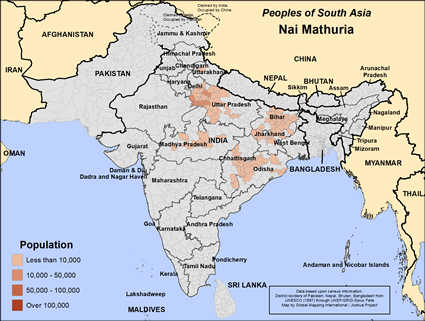
Map Source:
People Group data: Omid. Map geography: UNESCO / GMI. Map Design: Joshua Project
|
| People Name: | Nai Mathuria |
| Country: | India |
| 10/40 Window: | Yes |
| Population: | 172,000 |
| World Population: | 172,000 |
| Primary Language: | Hindi |
| Primary Religion: | Hinduism |
| Christian Adherents: | 0.00 % |
| Evangelicals: | 0.00 % |
| Scripture: | Complete Bible |
| Ministry Resources: | Yes |
| Jesus Film: | Yes |
| Audio Recordings: | Yes |
| People Cluster: | South Asia Hindu - Nai |
| Affinity Bloc: | South Asian Peoples |
| Progress Level: |

|
Introduction / History
The Mathuria Nai are a subgroup of the broader Nai community found mainly in Rajasthan, Madhya Pradesh, Assam, and nearby regions of northern and central India. They primarily speak Hindi and related regional dialects. Traditionally, the Nai were associated with barbering, grooming, ceremonial assistance, and matchmaking within village society. The Mathuria Nai developed as a distinct regional branch within this larger occupational community structure.
Historically, the Nai occupied an important role in Indian village life. Beyond cutting hair and shaving, they often carried messages between families, assisted during weddings and ceremonies, and helped maintain social relationships within the community. The Mathuria Nai, however, gradually expanded beyond traditional barbering in several regions. Many families became involved in agriculture, labor work, trade, and other village occupations as economic conditions changed.
Like many caste-based communities in India, the Mathuria Nai developed internal councils and social structures to preserve customs and regulate marriage and community affairs. Family lineage, social reputation, and caste identity continue to play important roles within the community. Modern education and urban employment have led younger generations into government service, business, transportation, and skilled trades, though many families still maintain ties to rural village life.
What Are Their Lives Like?
The lives of the Mathuria Nai vary between villages, market towns, and growing urban centers. Some families continue traditional grooming or salon-related work, while many others now work in farming, construction, transportation, small business, government service, and wage labor. Economic conditions differ widely between households, with some families experiencing stability while poorer rural laborers continue to face hardship and uncertain income.
Family and community relationships remain very important. Marriages are generally arranged within accepted caste and subgroup boundaries, and extended families often remain closely connected. The community traditionally practiced monogamy, though widowed or divorced individuals may remarry in many regions. Family elders and caste councils may still help settle disputes and preserve social customs.
Meals commonly include wheat, rice, maize, lentils, vegetables, and regional foods typical of northern India. Religious festivals, weddings, and village gatherings remain important parts of social life. Educational levels have gradually improved, though access to higher education and economic opportunity remains uneven, especially for girls and poorer households.
What Are Their Beliefs?
The Mathuria Nai primarily follow Hinduism and participate in both mainstream Hindu worship and regional folk religious traditions. Worship commonly includes devotion to Hindu gods and goddesses through temple visits, household rituals, offerings, festival celebrations, and ceremonies connected to births, marriages, and funerals. Religious identity is closely tied to family heritage and community custom.
Like many Hindu communities, the Mathuria Nai may also practice folk traditions involving astrology, ancestral customs, ritual purity, sacred vows, and fear of supernatural influences. Belief in karma and rebirth strongly shapes worldview and moral understanding. In some areas, reverence for Bhagat Sain, a medieval devotional figure associated with the Nai community, remains culturally important.
Although some Mathuria Nai may have heard of Christianity, many still have little understanding of the biblical gospel. Jesus is often viewed simply as another spiritual teacher or religious figure rather than the crucified and risen Son of God who alone provides forgiveness of sins and reconciliation with God. Clear biblical teaching and discipleship remain limited in many Mathuria Nai communities.
What Are Their Needs?
The Mathuria Nai need continued access to education, healthcare, vocational opportunity, and stable employment, especially among poorer rural households. Educational advancement for girls remains an important need in some traditional communities. Families dependent on seasonal labor or low-income occupations often face financial insecurity and limited social mobility.
Spiritually, the Mathuria Nai need faithful gospel witness communicated clearly in their own languages and cultural settings. Because oral communication and community relationships remain highly important, oral Bible storytelling, audio Scripture resources, and relationship-based discipleship can be especially effective. Many have never personally heard a biblical explanation of repentance, grace, forgiveness, and eternal life through Jesus Christ. Mature local believers and biblically grounded churches are needed to faithfully share the gospel among the Mathuria Nai and neighboring communities.
Prayer Points
Pray that the Mathuria Nai people will hear and understand the gospel clearly in their own languages and place their faith in Jesus Christ.
Pray that God will raise up mature local believers and church leaders who can disciple Mathuria Nai families and establish biblically faithful churches among them.
Pray that Mathuria Nai communities facing poverty, educational barriers, unstable employment, and social pressure will experience practical help and lasting hope.
Pray that the Mathuria Nai people will be adopted through the People Group Adoption program so that ongoing prayer, evangelism, discipleship, and church planting efforts will continue among them.