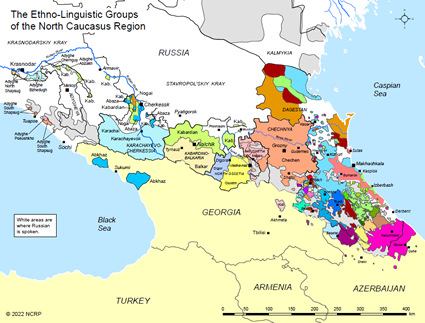

Over the past 600 years, the Karachay people have experienced life much like a grape placed in a wine press. Formerly part of the once mighty Alan Empire (nominally Christian), Turko-Mongol leader invader Timur defeated and forcibly converted the Karachay to Islam in the 14th century. Russian czarist imperialists conquered them in the 19th century, so the Karachays are very familiar with distress brought about by defeat at the hands of invading nations.
During World War II, the Germans swallowed them up as they advanced through the Caucasus Mountains. Then Stalin's Soviets re-conquered them. Due to their "acceptance" of German rule, Stalin then deported the Karachay numbering roughly 80,000 at the time from their Caucasus homeland to remote parts of Soviet Central Asia between 1943-57. Despite 35 percent of their population dying during the forced relocation, many Karachay have returned to their homeland and have begun repopulating their home area in the Russian province of Karachay-Cherkessia.
The Karachay of the Russian North Caucasus have preserved much of their heritage due to their Islamic cultural identity and their clan-organized communities, called Tukhum. Fiercely loyal within their Tukhum, Karachay have maintained strong family and cultural traditions best observed in weddings, funerals and over-the-top hospitality toward guests. Nevertheless, the Karachay's position on the global stage has not changed despite population growth and retaining cultural identifiers.
The Karachay culture, on the one hand, is devoted to 'duty ' but, on the other hand, is plagued by cycles of vengeance, corruption and male drunkenness. Their Islamic traditions represents a largely 'graceless' dynamic, with no clear understanding of forgiving grace and no indwelling Holy Spirit to revitalize.
The Karachay practice Sunni Islam tainted with folk religion.
Karachays need workers to share the gospel in the Karachay language and within the Karachay culture.
At present, less than 50 known Karachay followers of Jesus and only one evangelical church exist. The New Testament and Psalms in the Karachay language was completed in the 1990s. Even this is a better situation than what is faced by their highly unreached neighbors.
Pray for workers to go to the Karachays.
Pray for the New Testament and Psalms to be widely distributed.
Pray for workers and leaders to be raised up to disciple and lead the small group of believers and the one evangelical church.
Pray for the establishment of a viable, indigenous and reproducing Karachay church.
Scripture Prayers for the Karachay in Russia.
| Profile Source: Joshua Project |
| Other PDF Profile |