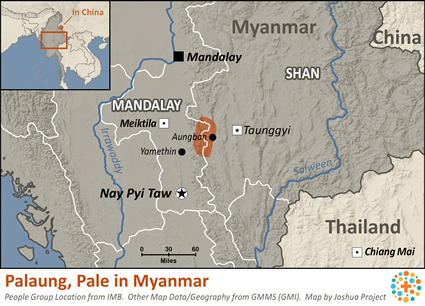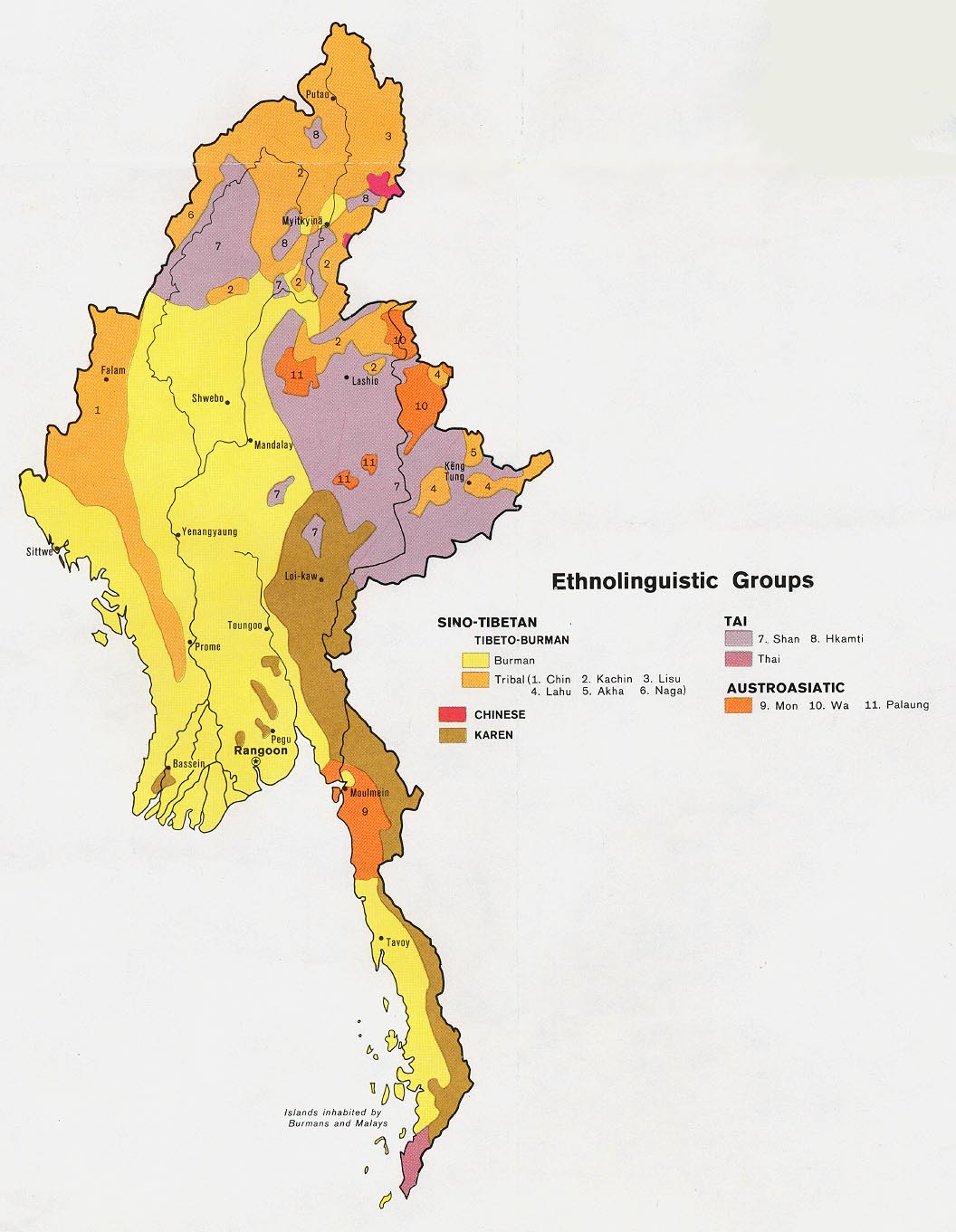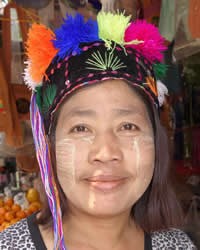

The Palaung are one of the largest and most visually striking tribes in Myanmar. "Palaung" is the Burmese name for this group. They call themselves Ta-ang, which means "Rock people." While some people call this group "Silver Palaung" due to their women's appearance, the autonym of the Palaung Pale is "Daraarin." Burmese sources list up to 15 different subgroups of Palaung in Myanmar, each wearing distinctive dress,1 while linguists have divided all the Palaung according to three distinct language groups, of which the Palaung Pale are the most populous.
The language spoken by Palaung Pale people is called Ruching. It is part of the Mon-Khmer branch of the Austro-Asiatic language family and contains six dialects. Depending on their location, Palaung Pale people also speak Burmese, Tai Lue, and Shan, and they use the scripts of those groups for writing.
Until the late 1950s the Palaung had their own prince who ruled from Namhsan in Tangpeng State, which existed from 1793 until the principality was abolished by the new Burmese Union in 1959. Fighting continued between the Burmese and the Palaung until a 1991 ceasefire. The Ta'ang National Liberation Army has emerged as one of the most powerful anti-government forces during the current Myanmar civil war. China, tired of having a war waged on its southern border, warned the TNLA leaders to stop fighting in 2024. When they refused to comply, China announced they were siding with the Myanmar junta to crush the many ethnic militias in the conflict.
In 1910 it was said of the Palaung: "They are conspicuous among the hill tribes of this region by their universal adoption of Buddhism, their tea culture, and the variety and elaboration of their women's dresses. For a tribe that lives so consistently on the hilltops as they do, they are a wonderfully advanced community." In the past the Palaung area prospered due to tea production, timber, and mining. They remain relatively wealthy today compared to other ethnic groups in Shan State.
The Palaung Pale are considered a strong Buddhist group that are not open to change. It is fascinating that they believe the Buddhist Lord of Mercy, Maitreya, will appear and establish justice and peace on the earth. According to 1920s missionary Alexander MacLeish, "No figure in all their religious horizon more quickly rouses their interest…. When Palaung build a new home, they always add an extra room in reserve for Lord Maitreya. The room is cleaned regularly even though members of the household never use it."
In 1953, the first Kachin missionary traveled east to Shan State to reach the Palaung people. A school was established, and Ai Sai became the first Palaung preacher.7 After initially experiencing an encouraging response, the work appears to have fallen into decline. Today, only a tiny remnant of less than one percent of Palaung Pale people are Christians. New believers often face persecution and are ostracized from the community. Using the Burmese script, the Bible was translated by missionaries and published in 2021, but appears to have been used selectively, and is not available for widespread distribution. The Jesus film in the Ruching language has been used to share the gospel with many Palaung Pale people.
Pray for the Lord to raise up a strong movement to Christ to saturate the hearts and minds of the Palaung Pale people.
Pray for God's blessing, strengthening and healing of Palaung Pale families and communities within this people group through the abundant life Jesus offers to all who call on his name.
Pray for God's blessing on the leaders in this people group, along with their families, and for their communities to welcome and enjoy God's blessing.
Pray for the Lord to multiply the reception and influence of his word among this people group, leading them to love him with their whole being.
Scripture Prayers for the Palaung, Pale in Myanmar (Burma).
Asia Harvest, Copyrighted 2026 © Used with permission
| Profile Source: Joshua Project |
| Other PDF Profile |