



Traditionally an artisanal culture, the Quechuas have adapted to many aspects of modern technology, including widespread use of iron, diesel trucks, heavy equipment, plastics, imported fabrics, entertainment, and communications technology. Today's material culture is a blend of the old and new, with traditional forms of expression taking on new shapes through technological adaptation.
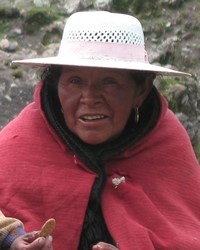
The modern Quechua-speaking woman clearly demonstrates this integration. There are two broad classes of Quechua ladies: the cholitas, whose traditional skirt, lacy top, and long thick braids are today a sign of pride among the Quechua, and the chotitas, who continue to speak in Quechua and maintain traditional practices but dress like the urban elite. Yet both groups of women love their cell phones, a factor that has served to homogenize and extend the use of the Quechua language.
The vast majority of Quechua speakers are functionally bilingual in Spanish, except in the most remote mountainous areas. The preference for Quechua is often justified by "It is sweet on the tongue" by everyone from engineers and lawyers to taxi drivers and farmers. Most remain in Bolivia, but there are minority populations in Argentina, Chile, and the United States.
Because Quechua speakers are found in every strata of society, generalizations are difficult. Broadly classed, there are 6 groups – miners/extractive, agriculturalists, colonizers (who have moved into the tropics to farm), construction, merchants, and the political/religious/teachers. As hard workers, the women spend most of their day either cooking for their extended family, interspersed with field work, or selling products in the market.
Food is of paramount importance. The saying is that a "Cochambino doesn't eat to live but lives to eat." For example, each traditional food demands a particular kind of potato. Each village is tremendously proud of its traditional food, and there are festivals that rotate from place to place throughout the year, celebrating its distinct styles of food.
Quechuas traditionally value the past more than the future, as the past can be easily seen and understood and the future is obscure. One practical expression of this cultural value is the tremendous burden of both respect and material aid that Quechuas place on their parents, placing their parents above their children. Another key to Quechua culture is the idea of the ayllu – a traditional extended family unit that provided structure to the community, the family, and a mutual defense against change. While most Quechuas are no longer part of a traditional ayllu unit, the ayllu value is today expressed through labor syndicates, neighborhood groups, and political action groups.
Today, the majority would self-identify as Christian, which is a set of traditional Andean religious practices set in a Roman Catholic matrix. The Roman Catholic church lost a lot of power and prestige during the revolution of 1952 and as a result, many people either left Roman Catholic church in practice or entered one of the various Evangelical church groups. As a result, there is a majority population in the Evangelical church that accepts many traditional Andean religious practices without ever seeing that they might be anti-Biblical.
Today, there is a great need expressed by evangelical church leaders for Bible training in their language. The Bible has been completely translated, but functional literacy is still relatively low in the Quechua language. So a two-pronged approach includes raising the comprehensive literacy of the leaders and, at the same time, deepening their understanding of the Bible. Discipleship in their language, while understanding the cultural context, is huge, and relationships take years to flower.
Radio Mosoj Chaski (New Messenger Radio) is a shortwave radio in Cochabamba that broadcasts in the morning and evening purely in Quechua. It reaches all of Bolivia and southern Peru as well, but possibly not Argentina. The radio offers an itinerant Bible school primarily to leaders in Potosi and Oruro that consists of seminars. Each seminar is conducted purely in Quechua, takes an average of 2 ½ days, and includes homework to be done before the next seminar. There is a complete Bible in their language.
Pray for a multiplying movement of disciples who will bring healing, unity, and lasting hope, transforming entire villages through the power of Christ.
Pray that soon they will become Christ's ambassadors to disciple less-reached nations.
Pray for the Lord to bless South Bolivian Quichua Christian believers with an abundance of God's love, joy, and kindness, drawing others to the King of kings.
Pray for them to be grateful for God's spiritual and physical provisions.
Pray that the Holy Spirit will move powerfully, so that they may become a light to those who still lack a relationship with Jesus Christ.
Scripture Prayers for the Quechua, South Bolivian in Argentina.
Benjamin Kelm
| Profile Source: Joshua Project |



