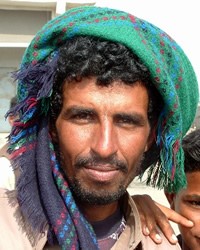

Rashaida in Sudan


Population
Main Language
Largest Religion
Christian
●
Evangelical
●
Progress
Progress Gauge
Is your organization working to bless this people group?
Profile placement
Sponsor this profile

Place your organization's card on this page for readers researching the Rashaida.

Sponsor this profile
People group adoption
Facilitating work among this people group?

Register in the People Group Adoption program so people who adopt the Rashaida can connect with you.

Register as a facilitator

Introduction / History

The Rashaida are probably related to the ethnic Bedouin tribes of the Arabian Peninsula. Originally, they roamed the deserts along the coastline of Red Sea. The name Rashaida means "refugee." At one time, the government of Eritrea waged war on them, making them incessant refugees. Rashaidas in Sudan speak Sudanese Arabic. They came to Eritrea from Saudi Arabia about 170 years ago, after escaping tribal wars and starvation. Now, they live in the northern coastal lowlands of Eritrea and the northern eastern coasts of Sudan where they have a higher population. In Sudan, they are particularly associated with Kassala State, the Red Sea region, the Sudan Eritrea border, and areas around Suakin and Tokar. They have inter-related communities on both sides of the border.


What Are Their Lives Like?

Rashaidas are primarily nomadic pastoralists. The herdsmen breed goats, sheep, and camels. Since they are largely illiterate, they memorize in detail the pedigree of their animals, keeping mental records of their herds over seven or eight generations of the flock, usually only emphasizing the female lines. Being nomads and herders, they live in tents made of goatskin and of camel or sheep hair.

They are known for their hospitality, and will sit down and have water, tea and coffee with strangers. Camel milk is an extremely important part of their diet as it is a fundamental source of their vitamins and proteins, making it their primary focus for herding.

Camel breeding is one of the primary sources of work for the Rashaida people. When they settled inland, the arid conditions of those areas led to them raising camels rather than cattle. They breed camels for meat to sell to the Egyptians, and for racing to sell to the Gulf States. The combination of animal-herding, occasional agriculture, and trade allowed the Rashaida to attain considerable prosperity, consisting mainly of large animal herds and gold stores. The men are excellent traders, using their camels and Toyota pickup trucks to distribute goods imported from Middle Eastern countries.

Rashaida women wear beautiful veils over their faces. They are famous for their black-and-red geometrically patterned dresses or brightly colored skirts and their burkas (long, heavy veils), which are elaborately embroidered with silver thread, beads and sometimes with seed pearls. Unlike other Arab and Muslim cultures, Rashaida women can keep part of their hair uncovered. They also adorn themselves with silver jewelry, which they craft themselves and often sell at local markets. Once a Rashaida girl reaches age 5, she is required to wear a veil that covers most of her face, except for her eyes. This practice begins when they are children so that no man besides their husband will ever see their face.

Families arrange marriages. Since the sexes do not mix freely in Rashaida culture, young men and women have few chances to meet of their own accord. However, if a Rashaida girl is ready to marry, she will approach the man she wants and flirtatiously lift her veil so that he can see her chin. If he accepts her offer, he must find 100 camels for her bride price.


What Are Their Beliefs?

The Rashaida are devout Sunni Muslims. Their culture revolves around the core concepts of Islam. Because of their mobile lifestyle, a family prayer house is central to their worship of Allah. Muslim missionaries reached them long ago, and they can participate in Islamic practices without a stationary building. It will be challenging but necessary for Christian missionaries to show them the way to the only Savior.

Until 1998, there were no known Christians among them. At that time, some Rashaidas in Eritrea put their faith in Christ. Pray they will reach Rashaidas in Sudan.


What Are Their Needs?

The Rashaida are slowly settling into villages, even though there is very less to no availability of proper health care or drinking water. Illiteracy is common, largely because of their lifestyle. There is a great need for Christian educational and gospel workers to reach the villages to transform them.


Prayer Items

Pray for physical and spiritual freedom for the Rashaida people.
Pray that the few Rashaida Christian believers from Eritrea will take the life-saving gospel to those in Sudan no matter what the cost.
Pray that God's grace and presence will sustain the imprisoned Sudanese Christians.


Scripture Prayers for the Rashaida in Sudan.


Profile Source:   Joshua Project  

People Name General Rashaida
People Name in Country Rashaida
Pronunciation ruh-shah-EE-dah
Alternate Names Rashad
Population this Country 149,000
Population all Countries 202,000
Total Countries 2
Indigenous Yes
Nomadic Agro-Pastoralists
Progress Scale Progress Gauge
Unreached Yes
Frontier Yes
Unengaged Yes
GSEC 1  (per PeopleGroups.org)
Pioneer Workers Needed 3
PeopleID3 14523
ROP3 Code 108307
Country Sudan
Region Africa, East and Southern
Continent Africa
10/40 Window Yes
National Bible Society Website
Persecution Rank 4  (Open Doors top 50 rank, 1 = highest persecution ranking)
Location in Country Primarily north   Source:  Ethnologue 2010
Country Sudan
Region Africa, East and Southern
Continent Africa
10/40 Window Yes
National Bible Society Website
Persecution Rank 4  (Open Doors top 50 rank, 1 = highest persecution ranking)
Location in Country Primarily north.   Source:  Ethnologue 2010
Primary Religion: Islam
Major Religion ▲ Estimated Percent
Buddhism
0.00 %
Christianity
0.00 %
Ethnic Religions
6.00 %
Hinduism
0.00 %
Islam
94.00 %
Judaism
0.00 %
Non-Religious
0.00 %
Other / Small
0.00 %
Sikhism
0.00 %
Unknown
0.00 %
Primary Language Arabic, Sudanese
Ethnologue Language Code apd
Ethnologue Language Familly Afro-Asiatic
Glottolog Language Family Afro-Asiatic
Written / Published Yes   (ScriptSource Listing)
Total Languages 2
Secondary Languages
Arabic, Hijazi
Primary Language Arabic, Sudanese
Ethnologue Language Code apd
Ethnologue Language Familly Afro-Asiatic
Glottolog Language Family Afro-Asiatic
Written / Published Yes   (ScriptSource Listing)
Total Languages 2
Secondary Languages
  Arabic, Hijazi

Primary Language:  Arabic, Sudanese

Bible Translation ▲ Status  (Years)
Bible-Portions Yes  (1927-1964)
Bible-New Testament Yes  (1978-2022)
Bible-Complete No
FCBH NT (www.bible.is) Online
YouVersion NT (www.bible.com) Online
Possible Print Bibles
Amazon
World Bibles
Forum Bible Agencies
National Bible Societies
World Bible Finder
Virtual Storehouse
Resource Type ▲ Resource Name Source
Audio Recordings Arabic Bible Online Arabic Bible Outreach Ministry
Audio Recordings Audio Bible teaching Global Recordings Network
Audio Recordings Stories of the Prophets Bible teaching General / Other
Audio Recordings The Historic Faith audio scripture The Historic Faith
Film / Video Jesus Film: view in Arabic, Sudanese Spoken Jesus Film Project
Film / Video LUMO film of Gospels Bible Media Group/LUMO
Film / Video Magdalena, Released from Shame: view in Arabic, Sudanese Spoken Jesus Film Project
Film / Video Story of Jesus for children: view in Arabic, Sudanese Spoken Jesus Film Project
Film / Video Walking with Jesus: view in Arabic, Modern Standard - East Africa Jesus Film Project
Film / Video World Christian Videos World Christian Videos
Film / Video قصة الانبياء / The Prophets' Story Create International
General Faith Comes By Hearing - Bible in text or audio or video Faith Comes by Hearing
General Scripture Earth Gospel resources links Scripture Earth
General Walk with the Prophets and meet the Messiah Al Massira
Mobile App Android Bible app: Arabic, Sudanese YouVersion Bibles
Mobile App Download audio Bible app as APK file Faith Comes by Hearing
Mobile App Download audio Bible app from Google Play Store Faith Comes by Hearing
Mobile App iOS Bible app: Arabic, Sudanese YouVersion Bibles
Text / Printed Matter YouVersion Bible versions as text YouVersion Bibles
Photo Source Vít Hassan - Flickr  Creative Commons 
Map Source Bryan Nicholson / cartoMission  
Profile Source Joshua Project 
Data Sources Data is compiled from various sources. Learn more.