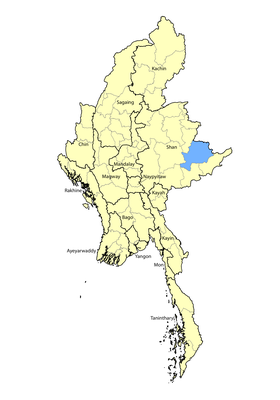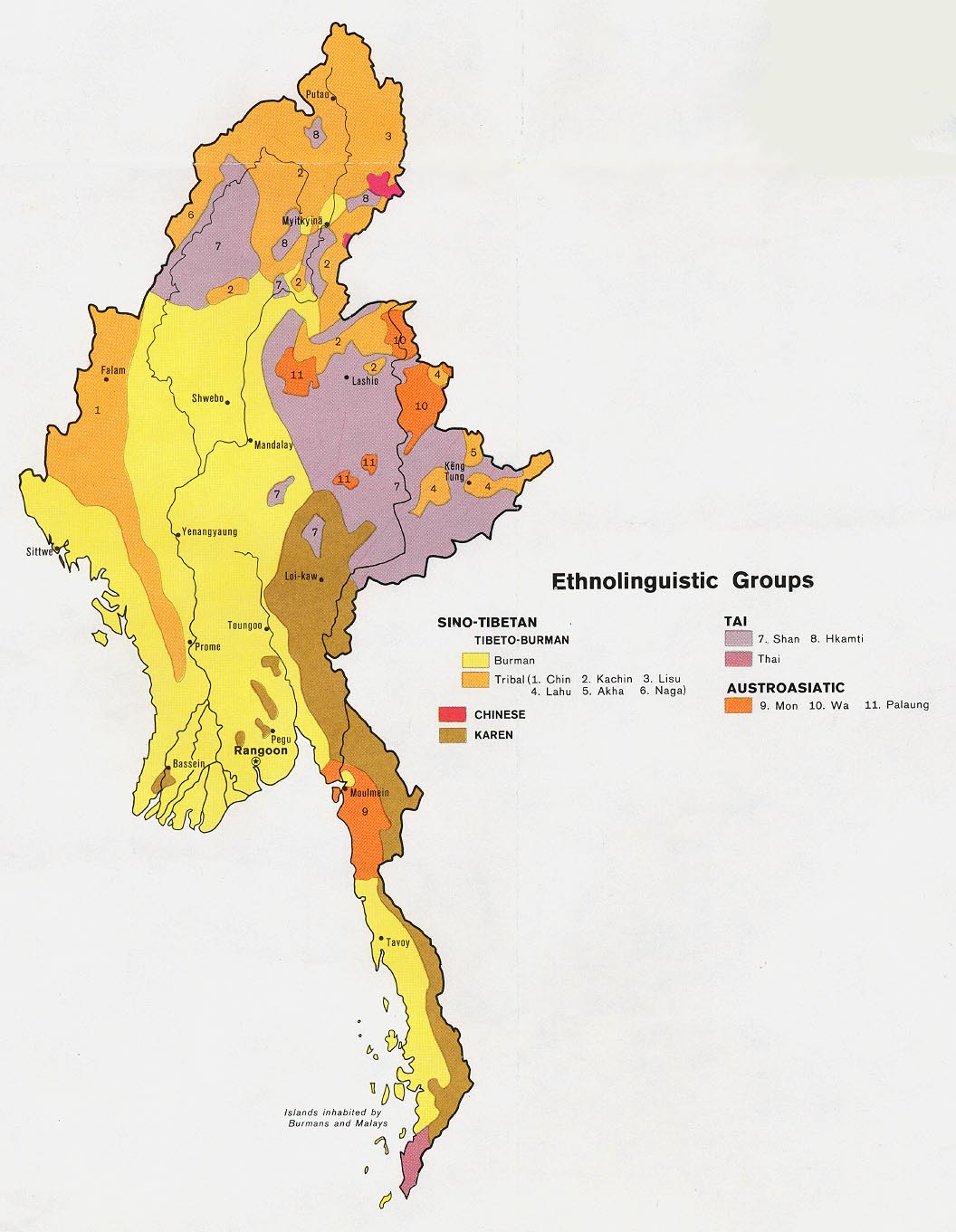

The Samtao people inhabit villages in Mongla Township, Shan State, Myanmar, situated between the Chinese border and the Nam Lwe River, a key tributary of the Mekong. Although Mongla is geographically within Myanmar, its electricity, telecommunications, and trade are heavily dependent on China, and the Chinese Yuan is the primary currency. The area remains sensitive and closed to foreign visitors due to its history of lawlessness and militia control prior to 1989. While local governance has improved, the Myanmar government still has no real authority in the region.
There is considerable confusion regarding the classification of the Samtao, as the name refers both to an ethnic group and to people from the Samtao mountains. In Myanmar, the Samtao are historically an alliance of three tribes: Samtao, Samtuan, and Sen Chun. Linguistically, Samtao belongs to the Waic branch of the Austro-Asiatic family, though its classification is debated, and most Samtao in Myanmar are also fluent in Burmese and Shan.
The Samtao villages consist of homes, typically built from bamboo and wood with thatched or tin roofs. They are built close together, reflecting the importance of family and community ties. Daily life revolves around subsistence agriculture, with families cultivating rice, maize, vegetables, and sometimes tea or sugarcane on small plots. Many households also raise chickens, pigs, or cattle to supplement their diet and income. Proximity to China allows some Samtao to engage in cross-border trade or seek work in local markets, though such opportunities remain limited.
Community life among the Samtao is characterized by cooperation and shared traditions. Festivals and celebrations are often aligned with the agricultural calendar. These events bring villagers together for communal meals, music, and dance, reinforcing social bonds and cultural identity. Religious and ancestral rituals play a significant role, with ceremonies held to honor spirits and seek blessings for the community. Despite modern influences and economic challenges, the Samtao people maintain a strong sense of unity and resilience, drawing strength from their land, traditions, and close-knit community. The Samtao people are known for absorbing aspects of neighboring cultures, adapting and blending traditions while preserving their own unique identity.
Samtao families may be monogamous or polygamous. To become a polygamous family, the husband must first receive permission from the village leader. In some Samtao families infant marriage is arranged.
Many Samtao people in Myanmar continue to practice traditional animistic rituals alongside Buddhism. Historical accounts, such as that of Presbyterian missionary William Dodd in the 1920s, describe the Samtao as long-standing and enthusiastic Buddhists. However, their religious life is a blend of beliefs. They honor spirits associated with the house, village, trees, sky, and forest, and also practice ancestor worship. A key annual event is the post-harvest agricultural ceremony, where chickens and pigs are sacrificed to the "mother of rice." Given their spiritual heritage, the Samtao remain an unreached group in Myanmar, with no scripture or Christian resources available in their language.
The Samtao people have significant spiritual needs, particularly access to the gospel in their own language and opportunities for discipleship and fellowship. Living in remote areas with little exposure to Christian teaching or scripture, it is difficult for them to hear about Jesus or grow in faith. Culturally sensitive outreach and ongoing encouragement are essential for nurturing any believers and helping the message of Christ become meaningful.
Physically, the Samtao often face challenges such as limited healthcare, clean water, and educational opportunities. Their reliance on subsistence farming leaves them vulnerable to food insecurity and poverty. Practical support through medical care, clean water projects, and agricultural training can help meet these needs and serve as a tangible demonstration of Christ's compassion. Addressing both spiritual and physical needs together is important in reflecting a more complete love of Jesus, who cared for both body and soul.
Pray for workers who are driven by the love and boldness of the Holy Spirit to go to the Samtao people and share the salvation message of Jesus Christ with kindness and love.
Pray for the Samtao people, that the Holy Spirit would open their hearts to the gospel, and compel them to pursue salvation in Jesus no matter the obstacles.
Pray that the Lord will provide translated scriptures and other Christian resources in the Samtao.
Pray that the Samtao people would experience increased access to schools, medical care, and sustainable livelihoods, empowering them to rise above the challenges of poverty.
Scripture Prayers for the Samtao in Myanmar (Burma).
Asia Harvest
1 To learn more about the Mongla area, see https://en.wikipedia.org/wiki/Mong_La
2 The people in Laos who call themselves Samtao may actually speak Lao with Mon-Khmer sounds. While they remember their historic roots as Samtao people, they do not speak the language anymore.
3 Harold Mason Young & Debbie Young Chase, Burma Headhunters: The History and Culture of the Ancient Wa, a Mountain Tribal People (Xlibris, 2014), p. 7. The name Sen Chun may be a derogatory term for the Mok, which is a different group and language.
4 See Joachim Schliesinger, Ethnic Groups of Thailand: Non-Tai-Speaking Peoples (Bangkok: White Lotus Press, 2000), p. 116; and the Ethnologue.
5 Summer Institute of Linguistics, Ethnologue: Languages of the World (27th edition, 2024), online version, says: "Samtao is used among the Palaungic peoples to refer to unintelligible dialects of Blang. In China, Samtao refers to Blang in Myanmar and occasionally to Blang from other China-based varieties with low intelligibility…. A third meaning refers to Blang who live in the Samtao area. Wan Phii Blang is a Samtao variety similar to and intelligible with Wan Sen and Wan Nyet, ancient Blang villages along the Mongla-Kengtung Road. A fourth meaning of 'Samtao' refers to Palaungic varieties more similar to Wa, such as the Pangloh, who also refer to themselves as Samtao. One Samtao village in Veng Phu Kha insists they speak the ancient Samtao language, but lexically it is Lao with Mon-Khmer phonology."
6 Debate on the classification of Samtao is seen in the curious situation where two respected linguists wrote opposing articles of the language in the same journal. See Gerard Diffloth, "On the Bulang (Blang, Phang) Languages," Mon-Khmer Studies (Vol. 18-19, 1992), pp. 35-43; and Debbie Paulsen, "A Phonological Reconstruction of Proto-Plang," pp. 160-222). Diffloth's article argues that Samtao is a Tai language term and is not the name used by the group themselves. Diffloth found that Samtao is the Blang language, while Paulsen disagreed.
7 James S. Olson, An Ethnohistorical Dictionary of China (Westport, CT: Greenwood Press, 1998), p. 298.
8 Young & Young Chase, Burma Headhunters, p. 7.
9 Paul Hattaway, Operation China: Introducing All the Peoples of China (Carlisle, UK: Piquant, 2000), p. 469.
10 Paul Hattaway, Peoples of the Buddhist World: A Christian Prayer Guide (Carlisle, UK: Piquant, 2004), p. 232.
11 William Clifton Dodd, The Tai Race: Elder Brother of the Chinese (Cedar Rapids, IA: The Torch Press, 1923), p. 213.
12 Schliesinger, Ethnic Groups of Thailand, p. 120.
| Profile Source: Joshua Project |
| Other PDF Profile |