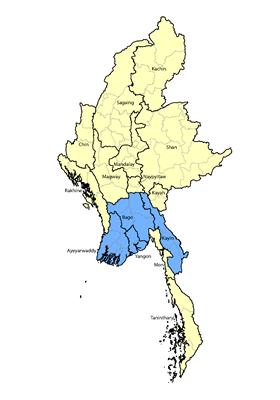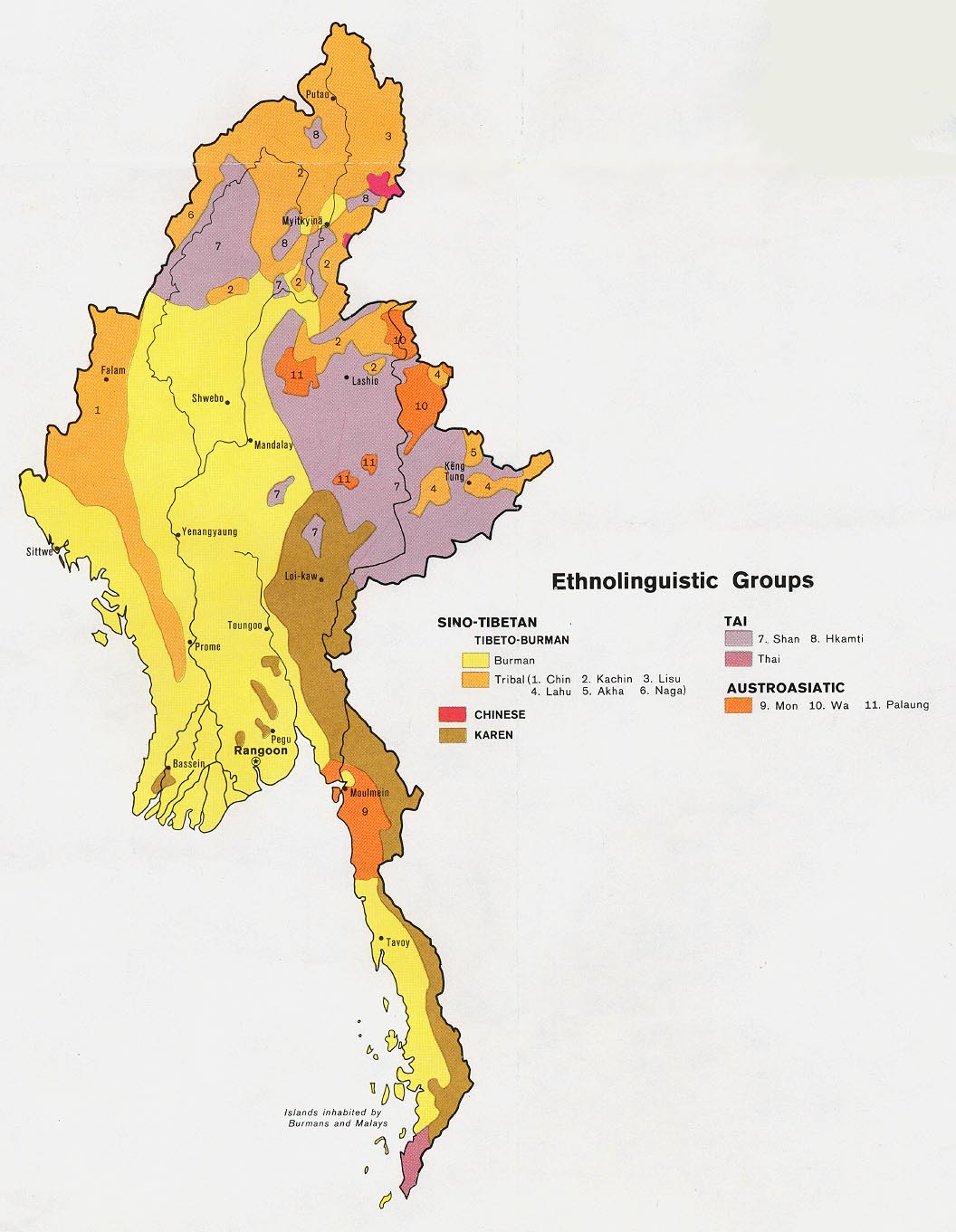

With a population, the S'gaw Karen are the fourth most populous ethnic group in Myanmar behind the Burmese, Shan, and Rakhine. They are widely distributed throughout all districts of Kayin State, parts of Mon and Kayah states, and in the three southern regions of Ayeyarwady, Bago, and Yangon, and diaspora communities in at least a dozen other countries. As a result of decades of civil war, many thousands of S'gaw Karen remain stuck in refugee camps, hoping to one day be resettled in a peaceful country.
The S'gaw Karen ethnic group became widespread in the mid-19th century after missionaries reduced their language to writing. This act gave great prestige to the S'gaw, and many smaller tribes joined them so they, too, could take advantage of having a written script. The 1931 census of Burma returned 517,540 S'gaw Karen people. They have nearly quadrupled in size since then.
S'gaw Karen is widely used in churches and for trade and is spoken as a second language by at least ten other Karen tribes. In recent decades the S'gaw Karen have seen a shift among the young toward using Burmese, although S'gaw, which has seven dialects, still enjoys vigorous use in the villages.
The Karen have been waging a long and brutal war against the Burnese government since 1948, with hundreds of thousands of their people raped and killed. Ironically, the Burmese and Karen are Tibeto-Burman groups that are believed to have migrated from China around the same time. The Karen sometimes even refer to the Burmese as their "brothers," but the Burmese have always despised the Karen, viewing them as an inferior race. Some commentators believe the fact that so many Karen became Christians has contributed to the barbaric treatment meted out to them by the Buddhist Burmese, which has devolved into ongoing genocidal warfare, including the use of chemical and biological agents.
In 1928 the Governor of Burma, Sir Charles Innes, told Karen leaders: "The future is full of hope for you…. With the Karens, education goes hand in hand with religion. Where there is a church, usually there is also a school. I have no doubt that the Karens are destined to play an increasingly important part in the life of this nation."
Although the S'gaw Karen are often viewed as a large Christian group, only about half of their population are followers of Christ. The rest are Buddhists and animists, with many people practicing a mix of the two.
Revival broke out among the S'gaw Karen almost as soon as the gospel reached them, as the message was considered the fulfillment of their long-held belief that God would one day send "white brothers" with a book that their ancestors had lost. More than one million S'gaw Karen identify as Christians today. Missionary Francis Mason had the honor of translating the Bible into S'gaw Karen.6 The New Testament was printed in 1843, followed by the full Bible in 1853.7 A S'gaw Karen common-language Bible was printed in 2003. Asia Harvest helped implement an ambitious project to provide a Bible to every S'gaw Karen family in Myanmar. By 2024 they had distributed 322,000 Bibles, which have transformed countless lives. A 78-year-old man named Kar said, "I started praying for a Bible when I was 24. After praying for 54 years, God has answered my petitions! I have received your free Bible and hymnal, and I am so happy! Even though I live in a simple thatch hut and I am all alone, Jesus Christ has not forgotten me and has encouraged me with his love!"
Pray for the S'gaw Karen people to become an example of what blessings come to communities that submit to the loving Savior.
Pray that S'gaw Karen believers will grow strong in their faith and become bold witnesses to their neighbors.
Ask God to raise up faithful leaders who will teach and model biblical truth.
Intercede for hearts to be fully committed to Jesus and for the Holy Spirit to bring renewal and transformation.
Scripture Prayers for the Karen, S'gaw in Myanmar (Burma).
Asia Harvest, Copyrighted 2026 © Used with permission
| Profile Source: Joshua Project |
| Other PDF Profile |