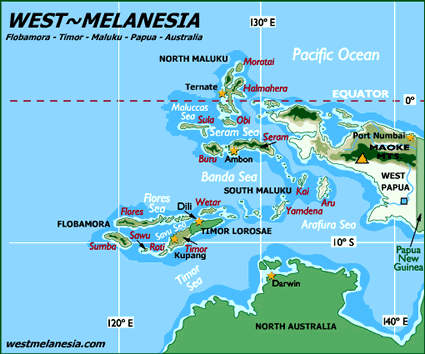
The Tehit (also spelled Tehid) people inhabit the southwestern portion of the Bird's Head Peninsula (Doberai) region in what is now Southwest Papua (formerly West Papua) Province, at or near the district of Teminabuan in South Sorong Regency.
Their language, known as Tehit, is a Papuan (West Papuan family) language with multiple dialects such as Tehiyit, Afsya (Mbol fle), and Sawiat-Salmeit among others.
Historically, the Tehit people are said to have migrated from the Toror cultural region of the Seget–Sele Peninsula, possibly driven by a natural tidal surge or major environmental shift, and settled in their current coastal and swampy homelands.
Traditional political structure once consisted of small territories (weri) such as Weri Ambuam (Teminabuan), Weri Sar, Weri Konda and Weri Kasrer, each led by local kings (for example the "Raja Kaibus") in earlier eras.
Over time, the Tehit people have encountered external influences, including missionary Christian work beginning in the early 20th century and pressures from modern Indonesian national integration.
The Tehit people live in a mixture of swamp-coast and upland forested terrain in their customary territory in South Sorong Regency. Many Tehit households subsist on harvesting sago from swampy forests and collecting wild animals and forest produce as sources of sustenance and income. In drier upland or forest areas, they engage in shifting cultivation of root crops such as taro, yams, pumpkins, and similar plantings. They also rely on wild animals—hunting forest mammals and gathering from local biodiversity—for protein and traditional uses.
While younger generations increasingly use Indonesian and Papuan Malay for daily communication, the Tehit language remains in use among older community members though its vitality is declining.
The community is also actively engaged in efforts to protect their customary lands, forests, and cultural heritage from external pressures such as agricultural expansion and resource extraction.
Among the Tehit people there is a mixture of Christian faith (particularly Protestant) and indigenous belief systems. According to tradition, the Tehit hold that the spirit of a deceased person goes to an afterrealm and remains concerned for their descendants. Should the descendants violate customary norms, the spirit may manifest in illness, misfortune or through wild animals, and only an appointed shaman may intervene through sacrificial or forgiveness rites.
The arrival of missionaries brought Christian belief and worship to the Tehit area, and many now attend church services and identify as Christian, whilst still holding cultural customs and ancestral respect.
Traditional lands, forest guardianship, communal ritual, and customary governance continue to hold spiritual significance. In many instances, the Tehit's Christian identity is contextualized within a framework of community, nature stewardship, and ancestral respect rather than adopting a purely Western secular form of faith.
Among the Tehit people, there is a strong interest in revitalizing their native language before it is lost, particularly among younger generations who may no longer learn it as their first language. In addition to cultural-language preservation, the economic livelihoods of the Tehit are shifting. As traditional sago-based and forest-based subsistence becomes challenged by land conversion, they require opportunities that align with their forest knowledge and customary land practices while enabling participation in regional development. Educational systems that incorporate and respect the Tehit language and culture alongside Indonesian schooling would help bridge generational gaps and improve local engagement. Land tenure and forest-rights issues also remain vital: the Tehit community's ancestral territory is under pressure, and secure recognition of customary rights to forests, hunting grounds, and sago swamps is essential for sustaining their way of life.
On the spiritual front, locally-relevant church engagement, Scripture and discipleship in the Tehit language and cultural context could strengthen faith and community coherence. As the world around them brings rapid change, the Tehit require resources and support that preserve their identity while enabling healthy adaptation to modern realities.
Pray for Christian workers and churches to minister among the Tehit with sensitivity to their culture and language, and for fresh faith and discipleship to be rooted in their own worldview rather than being solely imported.
Pray that soon, Tehits will be discipling others, including Muslims.
Pray for sustainable and culturally appropriate livelihood pathways for the Tehit people that build on their forest-and-sago traditions even as external changes arise.
Pray for educational opportunities.
Pray for protection of the Tehit's customary land, forests, and natural resources, and for respectful dialogue and recognition between them and external development interests.
Scripture Prayers for the Tehit in Indonesia.
Tehit people. Wikipedia.
"Tehit language." Wikipedia.
Hesse, Ronald Gerhard. Imyan Tehit Phonology. University of North Dakota, 1993.
UND Scholarly Commons
"Menjaga impian Suku Tehit." Antara Foto.
"The Utilization Of Wild Animals As A Source Of Protein By The Tehit Knasaimos Ethnic Group…" Median: Jurnal Ilmu-Ilmu Eksakta.
ejournal.um-sorong.ac.id
"Mother Language Imian – Training for Transformation (TFT) Papua."
papuatransformation.org
"Benefits of Dlimit Plant for Tehit Tribe in Traditional Area Knasaimos." Bentara Papua.
bentarapapua.org
"Suku Tehid – Papua." Sultans in Indonesie Blog.
| Profile Source: Joshua Project |