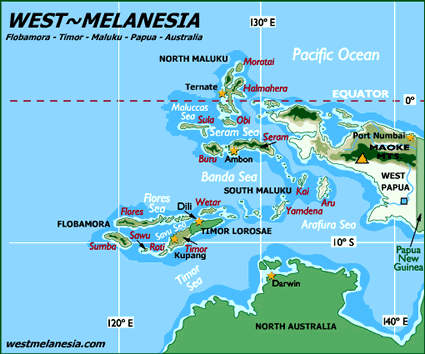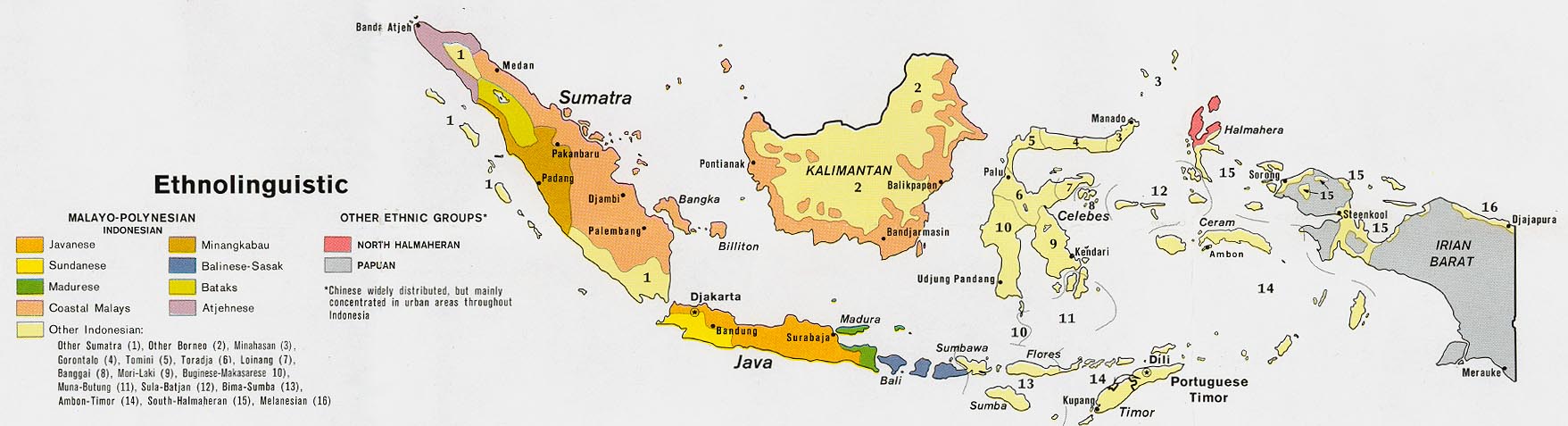
The Silen Teluti people are associated with the region around Teluti Bay on the southern coast of Seram Island in Maluku Province, Indonesia. The language of this group is known as Sepa?Teluti (sometimes given as just "Teluti") and belongs to the Central-Eastern Malayo-Polynesian branch of Austronesian languages.
Historically, this coastal bay area was influenced by inter-island trade, spice-island dynamics (cloves, nutmeg), and colonial era movements; over time, the local language and culture have been impacted by larger regional languages such as Ambonese Malay and Indonesian.
The identity of the Silen Teluti is therefore rooted in that coastal-Maluku maritime setting and in Austronesian heritage, though specific historic documentation of their separate tribal history is limited.
People of the Silen Teluti area dwell primarily in coastal villages and smaller settlements around Teluti Bay and the adjacent shores of Seram Island. Their livelihoods typically combine fishing, gleaning from coastal waters, and small-scale agriculture of crops suited to the tropical coastal environment (such as sago, coconuts, root-crops and local gardens) drawing on the reported economy of southern Seram.
Many local residents also engage in trade or labor related to regional ports and inter-island transportation, as the Maluku archipelago remains dependent on inter-island connectivity. The adoption of Indonesian and Ambonese Malay has grown for everyday communication, particularly in younger generations, while the traditional Teluti language is still used among older community members and in local contexts.
Modern pressures such as migration to urban areas, schooling in national languages, and economic shifts have affected family structures and social cohesion as well as customary village practices.
In Maluku Province, many coastal and island peoples have adopted either Islam or Protestant Christianity, often combined with residual animist or customary practices.
For the Silen Teluti area, while no detailed published study exists specifically for the group, it is reasonable to infer that the community follows one of the recognized major religions (Islam or Christianity) while also retaining local customary beliefs. For example, respect for ancestors, ritual linkages to land and sea, and local adat (customary) governance. The transition to national religions may have created a layered belief system in which the traditional worldview remains embedded beneath the surface of formal religious affiliation.
Preserving the Sepa-Teluti language and its oral traditions is important for maintaining cultural identity in the face of dominant languages and modern schooling. Economic opportunities that respect the coastal environment and traditional fishing/agriculture patterns would help ensure the community can thrive without sacrificing cultural heritage. Education that incorporates local language and worldview alongside national curricula would empower young people to remain engaged with their ancestral land while preparing them for wider society. Clarifying land and coastal rights, securing sustainable fishing access, and protecting natural resources would support community resilience. On the spiritual front, contextually-sensitive ministry and church engagement that understand local culture and worldview would provide pathways for deeper spiritual growth rooted in the community's own heritage.
Pray that churches and Christian workers would enter the Silen Teluti area with sensitivity, building on the community's worldview, and fostering genuine discipleship and community leadership.
Pray for them to realize God is their provider.
Pray for wise stewardship of the coastal and marine environment around Teluti Bay so that the people's livelihoods and culture may flourish sustainably.
Scripture Prayers for the Teluti, Silen in Indonesia.
Sepa-Teluti language. Wikipedia.
"Penelitian Bahasa di Maluku." Repositori Kemdikdasmen.
repositori.kemendikdasmen.go.id
"Seram Island – Maluku Tourism." Indonesia-Tourism.
indonesia-tourism.com
"Seram – Academic Kids." AcademicKids.
| Profile Source: Joshua Project |