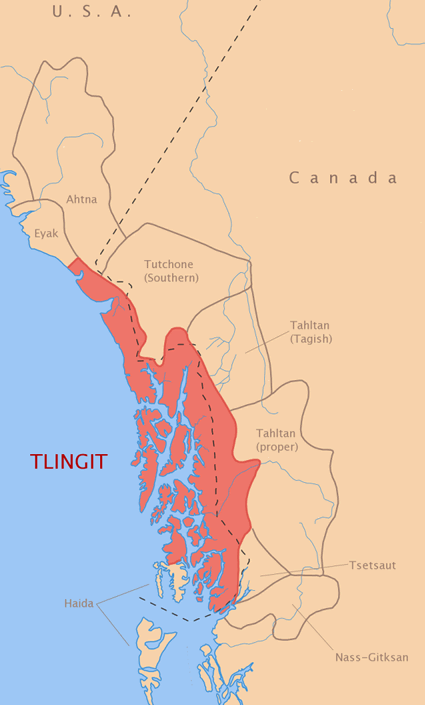
The Tlingit are an Indigenous people of the Pacific Northwest Coast, traditionally inhabiting the coastal and island regions of southeastern Alaska. Their language, Tlingit, belongs to the Na-Dene language family and is known for its complex grammar and rich oral tradition. For centuries, the Tlingit thrived in a maritime environment, relying on salmon, halibut, herring, and sea mammals, as well as berries and plants from the forest. They developed a sophisticated clan system divided into Raven and Eagle (or Wolf) moieties, with inheritance and social status traced through the maternal line. Art, song, and storytelling were central to their identity, expressed through carved totem poles, ceremonial regalia, and oral histories.
European contact in the 18th century brought trade, disease, and mission influence, profoundly reshaping Tlingit life while also opening new avenues for adaptation and resilience.
Many Tlingit people today live in coastal communities such as Sitka, Juneau, Hoonah, and Yakutat, as well as in other parts of Alaska and the Pacific Northwest. While modern education, business, and technology play a major role in daily life, traditional fishing, carving, weaving, and storytelling remain vital expressions of cultural identity. Clan relationships and ceremonial gatherings continue to provide a strong sense of belonging and continuity.
The Tlingit have been active in preserving and teaching their language, establishing immersion programs and cultural schools to ensure that younger generations can speak and understand Tlingit. Like many Indigenous communities, they face challenges related to economic opportunity, environmental change, and the effects of historical trauma, yet their resilience and community solidarity remain strong.
Before European contact, the Tlingit worldview was deeply spiritual, centered on balance, respect, and reciprocity with the natural world. Every creature, place, and event was understood to have spirit and meaning. Ceremonies honored clan ancestors, totemic animals, and the unseen forces that governed life.
With the arrival of Russian Orthodox and later Protestant missionaries in the 1800s, many Tlingit people adopted Christianity, while others integrated Christian faith with traditional spiritual understandings. Today, Christian congregations, especially Orthodox and Presbyterian, are active in many Tlingit communities.
The Tlingit people need continued support for revitalizing their language and preserving their oral traditions, which are central to identity and intergenerational continuity. There is a need for community-based healing programs that address the lasting impact of colonization, forced assimilation, and loss of traditional knowledge. Access to sustainable economic opportunities, housing, and healthcare—especially in rural areas—remains a challenge.
Spiritually, there is a need for ongoing discipleship and reconciliation efforts that honor Tlingit culture while strengthening faith in Christ. Empowering local leaders to express the gospel within Tlingit cultural forms could help bring deeper healing and renewal.
Pray that followers of Christ among the Tlingit would be bold and compassionate witnesses within their families and clans.
Pray for the work of the Holy Spirit in the hearts and minds of the many Tlingit who still cling to ethnic religions.
Pray for the faithful translation of the Bible in the Tlingit language.
Pray for the faithful translation of discipleship and outreach resources in the Tlingit language.
Pray for mission workers among the Tlingit people to be sensitive, patient, and guided by the Holy Spirit.
Scripture Prayers for the Tlingit in United States.
Sealaska Heritage Institute
Alaska Native Language Center, University of Alaska Fairbanks
National Museum of the American Indian
Wikipedia: Tlingit people and Tlingit language
| Profile Source: Joshua Project |