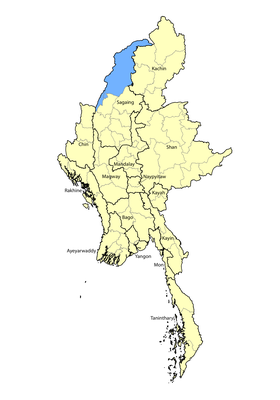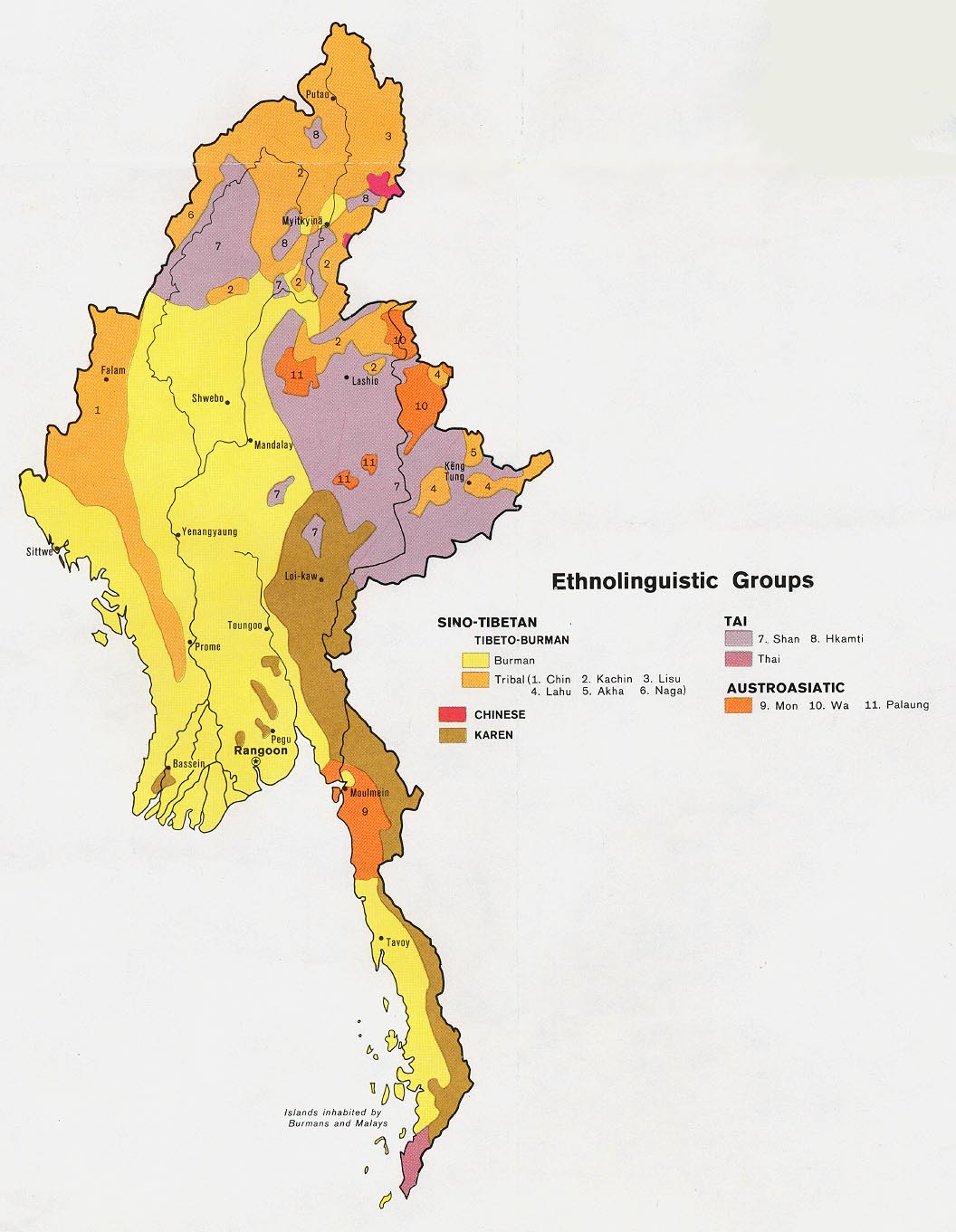

Living in western Myanmar, the Tangkhul Nagas live in Leshi, Tamu, and Homalin townships in a dense jungle area historically called the Somra Tract, after the name of the first Tangkhul village in Myanmar. Far more of them live in Manipur, India that Myanmar.
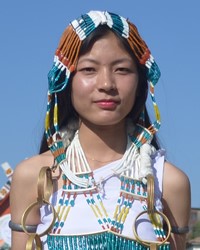
The Tangkhul are rare among Naga tribes in that they have appeared in official government lists of Myanmar's ethnic groups for almost a century. They appear to call themselves "Khaw" in their own vernacular, and their distinctive culture sets them apart from other Nagas in the region. In India, the Tangkhul Nagas have been described as a collection of tribes and clans rather than a cohesive ethnic group, with one visitor writing: "They are actually a hybrid, showing at least three sections of origin and customs." For many generations, Tangkhul men have worn a remarkably elaborate headdress, which is probably without equal in all of Asia. Each aspect of its design tells a story about Tangkhul life and history.
The Tangkhul language spoken in Myanmar is not closely related to any other Naga variety, including Tangkhul dialects across the border in India. Studies reveal that the Tangkhul spoken in Myanmar shares just 31% lexical similarity with Tangkhul in India, meaning that less than one-third of words are similar in both languages. Tangkhul also shares a 51% lexical similarity with Akyaung Ari Naga and 29% with Kokak Naga.
The Tangkhul in Myanmar claim to have arrived in the area after two brothers had a dispute. The younger brother, Rasu, "was defeated and moved eastward to found the village of Somra…around the end of the tenth century." One reason why the Tangkhul consist of so many different dialect subgroups may be that they expanded by conquering smaller groups in warfare and absorbing them into the tribal collective.
Tangkhul women are regarded as strong and independent, with many said to "excel in prestigious arenas like the civil services and academia…. Even during headhunting days, women used to act as mediators and intervene in the face of a crisis." They are also widely praised for their weaving skills, and Tangkhul products are sold throughout the region. In Leshi Township just a few years ago, "the Tangkhul still practiced the custom of paying the bridal price in the form of an axe, spear, a shawl, and a buffalo."
After centuries of worshiping evil spirits and practicing head-hunting, the Tangkhul Nagas gradually converted to Christ in Myanmar, and today approximately two-thirds are professing Christians, with the other third comprising Buddhists and animists. In India, an astonishing 98.1% of Tangkhul Naga people declared they were Christians at the time of the 2011 census.
Although Scottish missionary William Pettrigrew first preached the gospel among the Tangkhul Nagas in India in 1897, the message took years to penetrate the jungle into today's Myanmar, with the 1931 census of Burma failing to number any Tangkhul Christians. The church developed separately on each side of the border. The Tangkhul in India have had the New Testament since 1927; however, in Myanmar, Tangkhul believers had to wait until 1989 before the Bible was finally translated based on the dialect spoken in Somra village. The Bibles are still used today, but it is very difficult for Tangkhul Naga Christians to access copies.
What Are Their Needs?
Pray for revival fire to permeate Tangkhul Naga families and churches.
Pray that soon they will lead the way in taking Christ to ethnic groups that lack a gospel witness.
Pray for the Lord to bless their crops and livestock as a testimony of his goodness and power.
Asia Harvest
1 See "Weaving Across Borderlines—the Somra Initiative," Morung Express (May 20, 2013): https://morungexpress.com/weaving-across-borderlinesthe-somra-initiative. To this day, the Tangkhul Nagas consider the border between Myanmar and India to be an artificial line that doesn't reflect the reality of life in this tribal area: "The border imposed by the colonial rulers took no notice of either the wishes of the inhabitants nor their affiliations. The border was determined to align with physical features and make for ease of administration, and it drove right through Tangkhul country, leaving villages from this group on both sides of the border." J. D. Saul, The Naga of Burma: Their Festivals, Customs, and Way of Life (Bangkok: Orchid Press, 2005), p. 195.
2 Aglaja Stirn & Peter Van Ham, The Hidden World of the Naga: Living Traditions in Northeast India and Burma (London: Prestel Publishing, 2003), p. 49.
3 Saul, The Naga of Burma, p. 59, says: "The Tangkhul had a number of unique headdresses that were seen nowhere else in Myanmar. The most prominent of these, known locally as yakhat, was so distinctive that in the early days it was responsible for the northern Tangkhul being named lahupa, being the name of this hat in Manipur. It consisted of a plain cane helmet, woven out of broad sections of cane, with a circular piece of brass set centrally above the wearer's face, and with two round discs or 'ears,' rather like table tennis bats in appearance, set on projections to each side. The 'ears' were covered in red crab's eye seeds, with a border and center of white Job's tears (a type of grain) surrounding a large red seed, and with bear's fur around the edge. The brass plate symbolized a human head; the center seed of the 'ears' represented the chief of the village, the white seeds his followers, while the white seeds and bear's fur at the perimeter represented the village defenses. Over the top of the cane hat was fixed a subordinate framework that supported hornbill feathers sticking up vertically, representing 12 noble brothers."
4 Summer Institute of Linguistics, Ethnologue: Languages of the World (27th edition, 2024), online version.
5 Saul, The Naga of Burma, p. 20.
6 Dipti Bhalla & Shiv Kurnal Verma, Life and Culture in Northeast India (New York: Abbeville Press, 2020), p. 190.
7 Olk Bon, Culture Change among the Naga Tribes of Myanmar: The Former Headhunters Seek to Modernize (Coppell, TX: Self-published, 2019), p. 16.
8 See https://en.wikipedia.org/wiki/William_Pettigrew_(missionary).
Scripture Prayers for the Naga, Tangkhul in Myanmar (Burma).
| Profile Source: Joshua Project |
| Other PDF Profile |