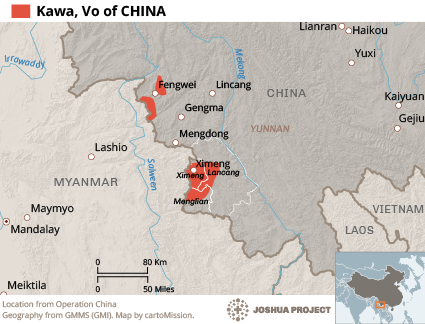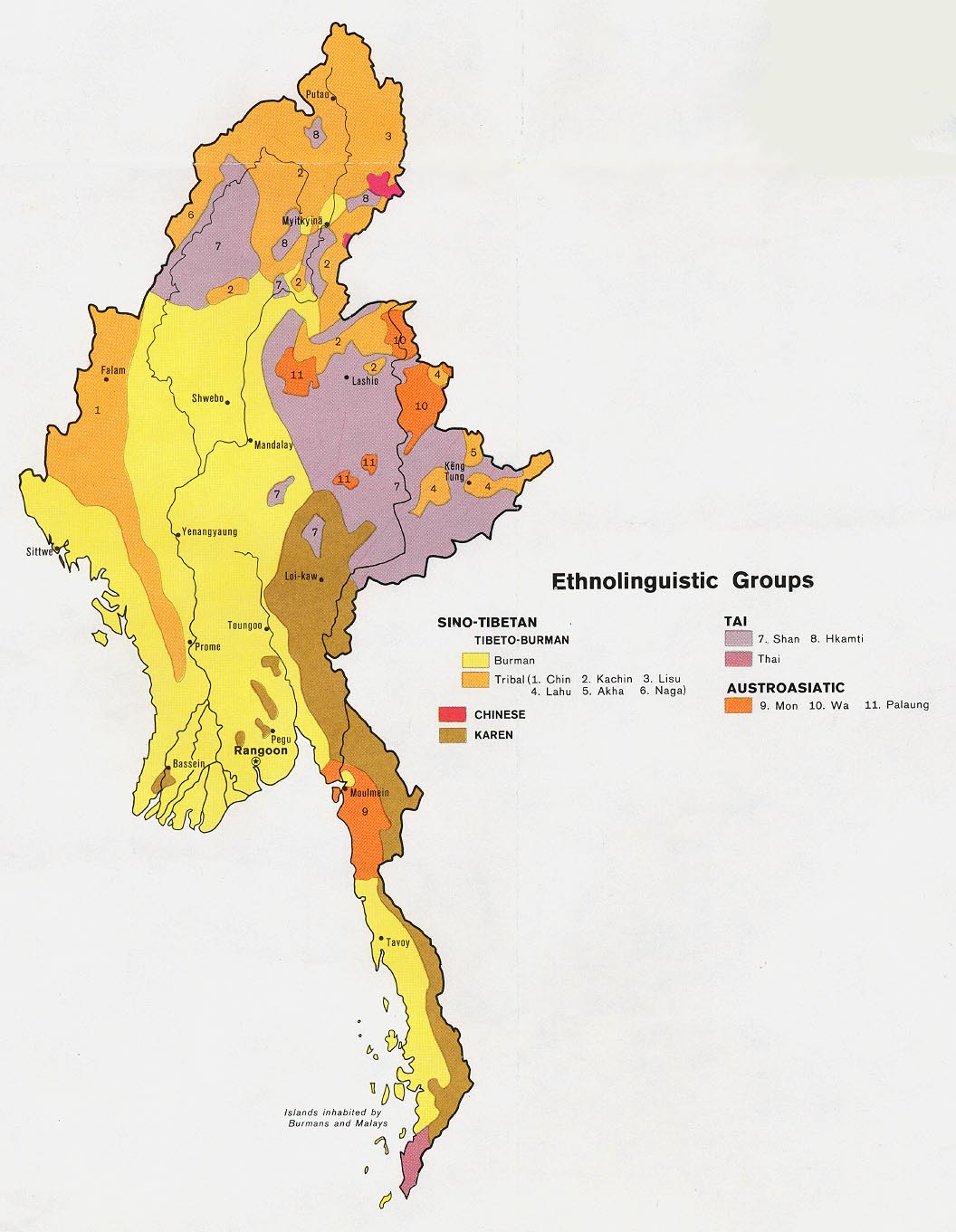

The Vo Wa live in borderland valleys along the frontier between northern Myanmar and southwestern Yunnan in China, and their main language is Vo, a distinct variety within the Wa cluster. Linguistic overviews treat Vo as one of several Wa varieties and note limited mutual intelligibility with some other Wa vernaculars. Vo communities form part of the broader Wa cultural area and maintain long-standing cross border ties that shape family networks and economic exchange.
Regional reporting and administrative summaries document evolving governance and security dynamics in the Wa borderlands that affect local communities. Missionary and translation efforts have produced substantial scripture material in a Wa orthography, and those publications have influenced literacy and religious life in parts of the Wa area.
Vo Wa communities sustain livelihoods adapted to upland and borderland environments, with subsistence agriculture, forest product gathering, and local trade forming the economic base. Village life is organized around kin networks and customary institutions, and many families maintain cross border connections with communities in Yunnan that shape seasonal movement and market activity. Contemporary pressures include changing administrative arrangements, security dynamics, and shifting economic opportunities that influence migration and livelihood choices.
Religious life among Vo Wa communities reflects a mixture of traditional animist practices and influences from neighboring religious traditions. Ethnographic and mission accounts document that some Wa communities have adopted Christianity, while many families continue customary ritual practices tied to local cosmologies. The presence and influence of Christian congregations vary by locality, and responses to outside religious influences differ across villages.
Vo Wa communities need support for language maintenance and culturally appropriate education in the Vo variety to sustain intergenerational transmission. Improved access to healthcare and basic services in remote villages is a priority, as is development of sustainable livelihood options that respect local ecological knowledge. The evolving administrative and security environment in the borderlands creates additional needs for reliable information, safe cross border access for families, and locally tailored development responses that engage customary leaders and community priorities.
Pray for believers from among the Vo Wa to become Christian workers, for the Holy Spirit to guide them and their families.
Pray for the Holy Spirit to bring revival fire to their families and churches.
Pray for improved access to healthcare and for practical support for families facing medical challenges.
Pray for expanded educational and vocational opportunities for children and youth, and for those in government and local leadership to make wise and just decisions that benefit the community.
Pray for preservation of the Wa language and cultural knowledge and for sustainable stewardship of their local environment and natural resources.
Scripture Prayers for the Wa, Vo in Myanmar (Burma).
Wa language — Wikipedia
Vo Wa language data — Max Planck Institute linguistic resources
Wa Self-Administered Division — Wikipedia
Hopang Township — Wikipedia
Reporting on administrative and security changes in the Wa borderlands — The
| Profile Source: Joshua Project |
| Other PDF Profile |