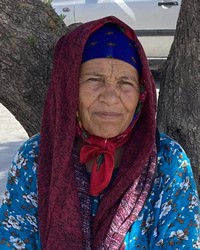

The Imazighen, also known as Berbers, are the indigenous people of North Africa. The singular term is Amazigh. They are a strong and proud people. The very name Imazighen is often translated to mean "free or noble men." There were people from North Africa present in Jerusalem at the day of Pentecost. The church was established among Berbers in the early centuries of Christianity, and some of the great North African church fathers were of Berber heritage. The symbolism of the cross can still be found throughout Imazighen architecture, designs on handmade carpets, and even tattoos on women's faces.
Today, however, they have no understanding of their Christian heritage. When Islam swept through North Africa in the 7th century, many pockets of Imazighen tried to fight the invasion. They resisted Islam's advance ten different times in history, outwardly saying they would become Muslims, but then returning to their villages and refusing to practice the religion. They intentionally built conspicuous white mosques at the top of the mountains to deceive Muslim invaders. As they passed, seeing the mosque in the distance, they would assume the village had already converted and continue on their way. Early generations kept their Christian heritage in secret and outwardly submitted to Islamic rule.
There are many Imazighen tribes. One of them is the Zaghouan. They live in the mountains of Tunisia in a town bearing their name. This town is 50 miles south of Tunis, the Tunisian capital.
The Zaghouan have lost many Imazighen traditions and customs because of integration with the Arab majority. There are differences in the ways Arabs and Imazighen relate to one another. They take great pride in their Imazighen origins. The Imazighen are unified in many ways. There is a youth center in the village that hosts youth activities. They build their homes close together. Their normal lives, in many ways, resembles the lives of their Arab neighbors.
Imazighen work in both public and private business as well as in factories. The Zaghouan Imazighen no longer speak their own dialect. However, since the revolution in 2011 they have begun teaching and learning how to read and write the Imazighen script.
The Zaghouan population depends on agriculture and shepherding. The ancient Roman ruins located near the city allow them to use tourism as an important part of their economy. Men in this village travel to other villages to work in construction. Those that live on the mountain lack adequate water and electricity.
The Imazighen in Zaghouan are Malaki Muslims, following the Arab Tunisian majority. The Malaki rely on the teachings of the Koran and the Hadith; one of the four schools of Sunni Islam. Muslims follow the teaching of Mohammad, who lived in the 6-7th centuries in Saudi Arabia. They believe in one God, whom they call Allah (Arabic for "the God"). At judgment day, all people will be judged for their deeds and, if their good works outweigh their bad, then Allah will welcome them into paradise. If not, then they will be sentenced to hell. To obtain salvation, they must follow the five pillars of Islam: prayer five times a day, fasting from dawn to dusk during the month of Ramadan, giving to the poor, and, if possible, a pilgrimage to Mecca, to be done at least once in their lifetime (Hajj). Regarding Jesus, they believe that he was a prophet, but that his teachings are inferior to those of Mohammad.
The Zaghouan Imazighen might not have Christ followers among them, and there are almost none in Tunisia. Who will go to them? Are there Christ followers in Tunis who will go?
Pray for their needs for clean water and electricity to be met.
Pray for spiritual hunger and discernment among the Zaghouan people.
Pray for the Lord to thrust out loving disciple makers to the Zaghouan people.
Pray for Zaghouan disciples to make many disciples.
Scripture Prayers for the Amazigh, Zaghouan in Tunisia.
| Profile Source: Joshua Project |