




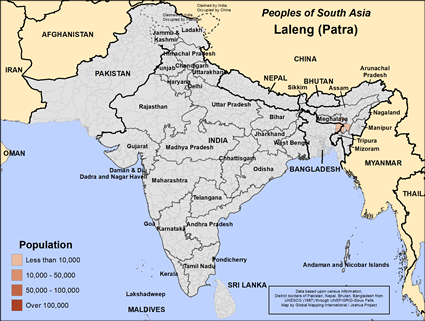
At one time, the Lalengs migrated from Southwestern China to their current home in southeastern Bangladesh. The Laleng, also known as Patra, are an indigenous ethnic group primarily residing in the Sylhet region of northeastern Bangladesh. They are considered one of the oldest tribal communities in the area, with a history that predates the arrival of other major groups. The Laleng trace their ancestry to ancient settlers of the region and have traditionally lived in forested and hilly areas. Over time, they have faced marginalization and displacement due to deforestation, land loss, and the expansion of tea estates. Despite these challenges, the Laleng have preserved aspects of their unique language, customs, and social organization.
The Laleng people typically live in small, scattered villages within the tea garden areas and forested hills of Sylhet. Their traditional livelihood centers on agriculture, forest gathering, and labor in tea estates. Many Laleng work as daily wage laborers, both in agriculture and in the tea industry, which often leaves them economically vulnerable. Their homes are usually simple bamboo structures, and community life is organized around extended families and clan systems. Social gatherings, folk songs, and dances are important aspects of their cultural life. Access to education and healthcare is limited, and many Laleng children do not complete formal schooling, contributing to ongoing cycles of poverty.
The Laleng traditionally practiced animism, with a belief system centered on nature spirits, ancestors, and local deities. Rituals and festivals were conducted to seek blessings for harvests, health, and protection from evil spirits. Over time, most Laleng have adopted elements of Hinduism, especially due to interaction with neighboring Bengali communities, but many still retain their indigenous spiritual practices. There are very few Christians among the Laleng, and the gospel has had limited impact in their community. Religious festivals, traditional healers, and rituals remain integral to their spiritual and social life.
The Laleng community faces significant challenges, including poverty, lack of access to quality education, and limited healthcare facilities. Many Laleng villages are isolated, making it difficult for residents to access government services and development programs. They are losing political power to the Bangladeshi majority even at the local level, led by panchayats. There is a need for advocacy to protect their land rights and prevent further displacement. Economic development initiatives, such as skills training and support for sustainable agriculture, could help improve their livelihoods. The preservation of the Laleng language and cultural heritage is also important, as younger generations are increasingly assimilated into mainstream Bengali society. They are a poor community with a low literacy rate. Spiritually, the Laleng need access to the gospel in their own language and culturally relevant discipleship resources.
Pray for improved access to education, healthcare, and economic opportunities for the Laleng people.
Ask God to protect the Laleng from further land loss and to provide justice and security for their communities.
Pray for the preservation of the Laleng language and cultural traditions amid pressures of assimilation.
Intercede for open doors for the gospel among the Laleng, and for the development of Christian resources in their language.
Pray for wise and compassionate leaders to rise up within the Laleng community to guide them toward holistic transformation.
Scripture Prayers for the Laleng (Patra) in Bangladesh.
https://en.banglapedia.org/index.php/Laleng
https://www.iwgia.org/en/bangladesh/3617-iw-2020-bangladesh.html
https://www.ethnologue.com/language/lln
https://www.dhakatribune.com/bangladesh/nation/2021/08/09/laleng-community-in-sylhet-struggles-for-survival
AI generated by Chatgpt
| Profile Source: Joshua Project |



