


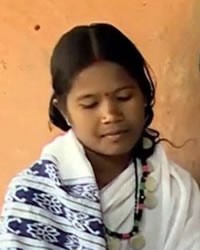

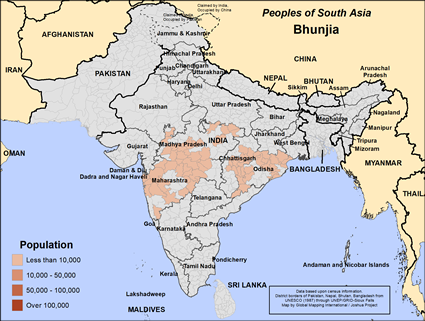
The Bhunjia live primarily on the Sunabeda Plateau in the border area between Odisha and Chhattisgarh in eastern India, and their main language is Bhunjia (a Halbic Indo Aryan variety), with many community members also speaking regional languages such as Chhattisgarhi and Odia. Many also live throughout Madhya Pradesh, in central India.
Ethnographic and government accounts describe the Bhunjia as a Scheduled Tribe with two principal subdivisions, Chaukhutia (Chukutia) Bhunjia and Chinda Bhunjia. Origin traditions and oral histories recorded by regional scholars recount distinct foundation myths for these subdivisions. Historically, the Chaukhutia group has occupied more secluded hill areas of the Sunabeda plateau, while the Chinda group has had closer contact with neighboring tribal and nontribal communities. Administrative changes in the 20th century placed parts of their traditional territory across state boundaries, shaping contemporary settlement patterns.
The Bhunjia practice settled agriculture as a primary livelihood, cultivating local cereals and seasonal crops adapted to plateau conditions. Many households supplement farming with the collection of forest products, small scale animal husbandry, fishing where available, and wage labor. Material culture and housing reflect local ecological conditions; traditional houses are often earthen and thatch roofed, with daily household practices shaped by local resources.
Social organization includes clan and subtribal identities that influence marriage practices and ritual life. The Chaukhutia Bhunjia have historically maintained greater seclusion in upland hamlets, while the Chinda Bhunjia tend to live in more accessible plains and interact more frequently with neighboring groups. Oral literature, songs, and epic narratives form an important part of Bhunjia cultural expression and are documented in regional ethnographic studies.
Religious life among the Bhunjia combines elements of Hindu practice with indigenous tribal religious traditions. Community ritual calendars include observance of regional Hindu festivals alongside local ceremonies honoring ancestral and village deities. Bhunjia ritual specialists and singers preserve oral epics and mythic narratives that structure communal memory and ceremonial life. Practices and emphases vary between subgroups and localities and are described in ethnographic and folkloric studies.
Government and tribal research reports note development priorities common to Bhunjia communities, including improved access to education, healthcare, and livelihood support that strengthens agricultural productivity and alternative income sources. Literacy and school enrollment rates vary, and targeted programs have been implemented in some areas to support community development. Infrastructure needs—such as better road access and market linkages—affect economic opportunity, while culturally appropriate initiatives to document and sustain oral traditions and language use are relevant for cultural preservation. Local assessments are necessary to tailor interventions to the specific circumstances of Chaukhutia and Chinda Bhunjia settlements.
Pray for believers from among the Bhunjia to become Christian workers, for the Holy Spirit to dwell within them and guide them and their families, and for them to be accurate, loving influences of Christ to their friends and relatives.
Pray for improved access to healthcare and for practical support for families facing medical challenges.
Pray for expanded educational and vocational opportunities for children and youth, and for those in government and local leadership to make wise and just decisions that benefit the community.
Pray for the Lord to win, equip, and send workers to this Hindu community, for the glory of Christ's name.
Scripture Prayers for the Bhunjia in India.
Bhunjia — Wikipedia.
Chhattisgarh Tribal Research and Training Institute — Bhunjia profile and state tribal summaries.
Census of India / Government of India — Scheduled Tribe listings and district census summaries (Nuapada, Kalahandi, Raipur).
Mahendra Kumar Mishra, Oral Epics of Kalahandi and related regional folkloric studies (scholarly publications documenting Bhunjia oral tradition).
| Profile Source: Joshua Project |





