




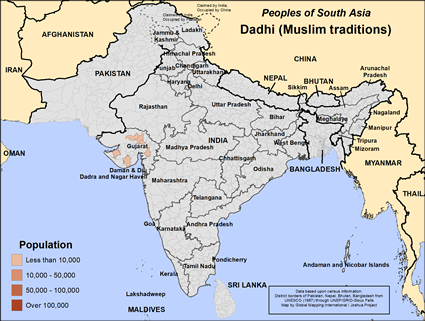
The Dadhi are a small Muslim community found primarily in the western Indian state of Gujarat, with a smaller presence in the neighboring coastal region of Daman and Diu. Their primary language is Gujarati, although some also speak Urdu. The name "Dadhi" is derived from a Hindi and Urdu word meaning "beard," and it is known as a surname among Indian Muslim communities.
Very little detailed historical information has been published about the Dadhi. Like many Muslim communities in western India, they have lived for generations within a diverse cultural environment shaped by trade, agriculture, Islamic traditions, and regional Gujarati customs. Their identity is tied both to their Muslim faith and to the broader social and cultural life of Gujarat.
Because they are a relatively small and little-studied community, the Dadhi have remained largely unknown outside their local areas. This lack of visibility has also contributed to limited gospel engagement and a scarcity of information about their culture and history.
The Dadhi are involved in a variety of occupations, reflecting the economic diversity of Gujarat. Some work in agriculture, cultivating crops or assisting with farm operations in rural areas. Others are engaged in trade, operating small businesses, working in local markets, or participating in the commercial networks for which Gujarat has long been known. Still others serve in government positions or pursue professional employment.
Family relationships play an important role in Dadhi society. Like many Gujarati Muslim communities, family life often centers on strong ties between parents, children, grandparents, and extended relatives. Weddings, religious celebrations, and family gatherings reinforce social connections and community identity.
Food reflects both Gujarati culture and Muslim dietary practices. Meals commonly include flatbreads, rice, lentils, vegetables, and meat dishes prepared according to Islamic dietary guidelines. Hospitality is highly valued, and sharing food with relatives and guests is an important expression of respect and community.
Community life is often centered around neighborhoods, local markets, and mosques. Religious festivals provide opportunities for worship, fellowship, and strengthening family relationships. In urban areas, some Dadhi have benefited from educational and economic opportunities, while those in rural settings may remain more closely connected to agricultural life and traditional patterns of community interaction.
Although modernization has brought new opportunities, many families continue to balance contemporary influences with longstanding cultural traditions. Their identity is shaped by both their Gujarati heritage and their Muslim faith.
The Dadhi are Sunni Muslims. Their religious life is shaped by the teachings of the Qur'an, the example of the prophet Muhammad, and the practices of the wider Sunni Muslim community. Daily prayers, fasting during Ramadan, charitable giving, and participation in Islamic festivals are important expressions of faith.
In addition to mainstream Islamic beliefs, the Dadhi maintain community traditions that have developed within their local cultural setting. As is common among many South Asian Muslim communities, religious practice may include customs and traditions that have been passed down through generations alongside formal Islamic observance.
The mosque serves as an important center for worship, religious instruction, and community life. Through family and community networks, Islamic beliefs are passed from one generation to the next.
Despite having access to Scripture resources in Gujarati, very few Dadhi have had meaningful exposure to the gospel or sustained interaction with followers of Jesus Christ.
The Dadhi have significant spiritual needs. Most have little opportunity to hear a clear and culturally understandable presentation of the gospel. They need believers who are willing to build genuine friendships, demonstrate Christ's love, and communicate biblical truth with wisdom and respect.
Because Christian resources are available in Gujarati, there is an opportunity for Scripture engagement if workers and ministries can establish meaningful relationships within the community. Who will take it to them?
Practically, some Dadhi families would benefit from expanded educational opportunities, vocational training, healthcare access, and economic development initiatives. As with many communities in India, stable employment and quality education can provide greater opportunities for future generations.
Long-term Christian witness, compassionate service, and culturally sensitive discipleship are needed so that the Dadhi can encounter the transforming message of Jesus Christ.
Pray that the Dadhi people will be adopted through the People Group Adoption program so that sustained prayer, intentional engagement, and future gospel ministry will reach their communities.
Pray that Christians will be led by the Holy Spirit to develop meaningful relationships with the Dadhi and faithfully share the good news of Jesus Christ with them.
Pray that a deep spiritual hunger will arise among the Dadhi, leading many to seek Jesus Christ and follow him no matter what the cost.
Pray that God will provide improved educational opportunities, healthcare services, employment options, and other practical resources that strengthen Dadhi families and communities.
Scripture Prayers for the Dadhi (Muslim traditions) in India.
https://www.britannica.com/place/Gujarat
| Profile Source: Joshua Project |




