




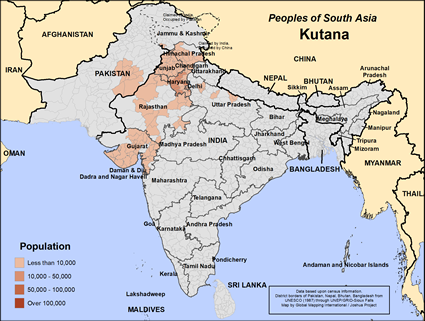
The Kutana are a Hindu community found mainly in the western Indian states of Gujarat and Rajasthan, with smaller populations in nearby regions. They are considered a socially marginalized community and have historically occupied a low social position within the broader caste structure of Indian society. Most Kutana speak Hindi, Gujarati, Rajasthani, or related regional dialects depending on where they live. Their identity has traditionally been connected to laboring occupations, rice milling, transportation work, and small-scale business activity.
Historically, many Kutana families were landless and dependent on daily labor or small trade for survival. Community councils and caste associations developed to help regulate social life, preserve customs, and provide mutual support within the community. Over generations, economic hardship and limited educational access contributed to continuing social and financial struggles for many Kutana households. Although modernization has brought some change, many families still remain economically vulnerable and socially overlooked in both rural and urban settings.
Some Kutana families became involved in rice milling and transport-related occupations as local economies changed. Portable rice milling equipment became especially valued among portions of the community because it allowed families to earn income independently. Despite these adaptations, many Kutana still face unstable employment and limited social mobility.
Many Kutana families work as day laborers, transportation workers, small traders, rice mill operators, or agricultural laborers. Some are involved in local politics or community leadership, though most continue to live with economic uncertainty. Land ownership is uncommon in many Kutana communities, making families heavily dependent on seasonal labor or small-scale business activities for survival.
Family and community relationships remain important within Kutana society. Community associations and councils often help settle disputes and preserve traditional customs. Marriages are generally arranged within accepted social boundaries, and respect for elders continues to shape family life. Educational opportunity has gradually improved for some younger generations, but boys are often given greater educational priority than girls in more traditional households.
Meals commonly include rice, lentils, flatbreads, vegetables, and locally available foods typical of western India. Religious festivals, weddings, and community gatherings remain important social events that strengthen cultural identity and family ties. In poorer communities, access to healthcare, sanitation, stable housing, and long-term educational opportunities may still remain limited.
The Kutana primarily follow Hinduism mixed with local folk religious traditions. Worship commonly includes devotion to Hindu gods and goddesses through temple visits, offerings, prayers, festival celebrations, and household rituals. Religious identity is often inherited through family and community tradition rather than through personal study of sacred texts.
Like many Hindu communities in western India, the Kutana may also practice folk traditions involving local deities, ancestral customs, astrology, ritual purity, and fear of supernatural forces. Belief in karma and rebirth strongly shapes worldview and moral understanding. Rituals connected to blessing, protection, prosperity, and relief from suffering may influence daily religious life.
Major Hindu festivals such as Holi, Diwali, Navratri, and Rama Navami are commonly observed. In many communities, religion is closely connected to cultural identity, family loyalty, and social expectations. Although some Kutana may have heard of Jesus Christ, many still have little understanding of the biblical gospel or salvation through grace by faith in Christ alone.
The Kutana need improved access to education, healthcare, vocational training, stable employment, and economic opportunity. Landless laborers and poorer families often face ongoing financial insecurity and limited social mobility. Greater educational opportunities for girls and women would especially benefit many communities.
Spiritually, the Kutana need faithful gospel witness communicated clearly in their own languages and cultural settings. Many have never heard a biblical explanation of repentance, grace, forgiveness, and eternal life through Jesus Christ. Strong local churches, Scripture access, discipleship, and long-term relationship-based ministry are needed so Kutana families can clearly hear and understand the gospel. Existing believers in Gujarat and Rajasthan also need encouragement and training so they can faithfully reach Kutana communities with biblical truth.
Pray that the Kutana people will hear and understand the gospel clearly in their own languages and place their faith in Jesus Christ.
Pray that God will raise up mature local believers and church leaders who can disciple Kutana families and establish biblically faithful churches among them.
Pray that Kutana communities facing poverty, limited education, unstable employment, and social marginalization will experience practical help and lasting hope.
Pray that the Kutana people will be adopted through the People Group Adoption program so that ongoing prayer, evangelism, discipleship, and church planting efforts will continue among them.
Scripture Prayers for the Kutana in India.
https://peoplegroups.org/people_groups/pg041890/
https://www.britannica.com/topic/Hinduism
https://www.britannica.com/topic/caste-social-differentiation-India
https://en.wikipedia.org/wiki/Rice_milling
| Profile Source: Joshua Project |




