


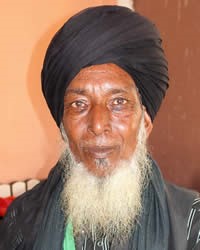

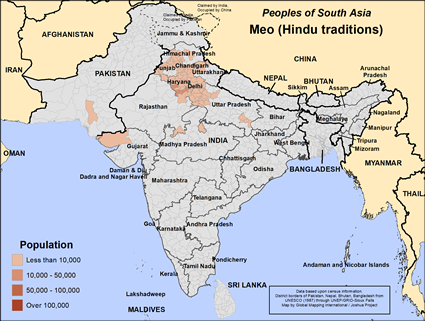
The Meo are a large community primarily found in the Mewat region of northwestern India, especially in Rajasthan, Haryana, and parts of Uttar Pradesh. While many Meo identify as Muslim, some communities continue to follow Hindu traditions or maintain religious practices strongly influenced by older Hindu customs and local folk beliefs. The Meo speak Mewati, a language closely related to Rajasthani and Hindi dialects. Their identity has historically been shaped by agriculture, clan loyalty, village life, and a strong regional culture rooted in the semi-arid Mewat region.
Historically, the Meo trace connections to Rajput, Jat, and Meena ancestry. Over centuries many adopted Islam while retaining significant portions of earlier social customs, kinship structures, and folk traditions. Some Meo communities continue to preserve practices that blend Islamic and Hindu cultural elements. Their history reflects a long process of religious and cultural transition rather than a sudden conversion from one identity to another. Clan identity, known as gotra, remains highly important and strongly influences marriage patterns and social organization.
The Mewat region historically experienced limited infrastructure, economic hardship, and political neglect, contributing to lower literacy and development levels compared to many surrounding areas. Even with modernization, many Meo villages still preserve traditional customs, oral storytelling, folk music, and agricultural lifestyles.
Most Meo families are involved in agriculture, livestock raising, daily wage labor, transportation work, or small local businesses. Farming remains central to village life, though the dry climate and irregular rainfall of the Mewat region often create economic uncertainty. Some younger Meo men migrate to cities for construction work, driving, factory labor, or other urban employment opportunities.
Family and clan relationships are extremely important within Meo society. Extended families often live close together, and marriages are generally arranged according to clan traditions that prohibit marriage within the same gotra. Community honor, loyalty, and respect for elders strongly influence social life. Traditional village councils may still help resolve disputes and maintain social customs.
Meals commonly include flatbreads, lentils, milk products, vegetables, and locally available meat dishes. Weddings, seasonal festivals, and community gatherings remain major social events. Folk songs, oral history, and storytelling traditions continue to preserve memories of ancestry and regional identity. Educational access has improved in some areas, though many villages still struggle with poverty, limited infrastructure, and lower educational attainment, especially among women.
The Meo communities identified with Hindu traditions generally practice a mixture of Hindu beliefs, folk religion, and customs influenced by neighboring Muslim culture. Worship may include devotion to Hindu gods and goddesses, reverence for clan deities, local shrines, ancestral customs, and rituals connected to protection, fertility, harvests, and family well-being. Folk beliefs involving spirits, curses, astrology, and supernatural powers may also influence daily life.
Because of the Meo community's long interaction with Islam, some customs and festivals may reflect blended religious influence. In certain areas, practices associated with saints, shrines, or local holy figures coexist alongside Hindu observances. This syncretistic religious environment can make spiritual identity more cultural and inherited than deeply grounded in biblical truth or clear theological understanding.
Although many Meo have heard of Christianity, large numbers still have little understanding of the biblical gospel. Jesus may be regarded simply as a respected prophet, teacher, or outsider religion rather than the crucified and risen Son of God who alone provides forgiveness of sins and eternal life. Clear biblical teaching and mature discipleship remain limited among many Meo communities.
The Meo continue to face challenges related to poverty, drought, limited healthcare, educational barriers, and unstable employment opportunities. Rural villages in the Mewat region often struggle with inadequate infrastructure, water shortages, and limited economic development. Women and children may be especially affected by lower educational access and healthcare limitations.
Spiritually, the Meo need faithful gospel witness presented in culturally understandable ways and in the Mewati language. Many have never heard a clear biblical explanation of grace, repentance, forgiveness, and salvation through Jesus Christ. Relationship-based ministry, oral Bible storytelling, Scripture access, and long-term discipleship are especially important in communities shaped by strong clan identity and oral tradition. Existing believers in the region also need courage, wisdom, and biblical maturity as they seek to share the gospel among the Meo.
Pray that the Meo people will hear and understand the gospel clearly in their own language and place their faith in Jesus Christ.
Pray that God will raise up faithful local believers and church leaders who can disciple Meo families and establish biblically grounded churches among them.
Pray that Meo communities facing poverty, drought, limited education, and healthcare challenges will experience practical help and lasting hope.
Pray that the Meo people will be adopted through the People Group Adoption program so that ongoing prayer, evangelism, discipleship, and church planting efforts will continue among them.
Scripture Prayers for the Meo (Hindu traditions) in India.
https://en.wikipedia.org/wiki/Meo
https://en.wikipedia.org/wiki/Mewat
https://peoplegroups.org/explore/GroupDetails.aspx?peid=41504
https://www.britannica.com/place/Rajasthan-state-India
| Profile Source: Joshua Project |




