




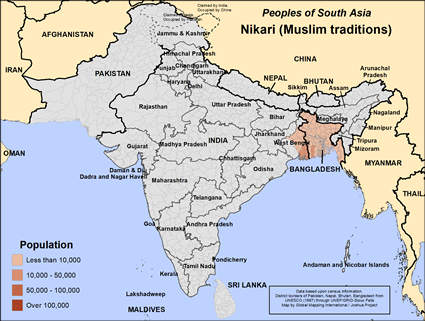
The Nikari are a Muslim community found primarily in West Bengal, particularly in the districts of North and South 24 Parganas, with related populations in neighboring Bangladesh. They speak Bengali as their primary language and are part of the broader Bengali Muslim cultural world. The name "Nikari" is traditionally associated with the idea of earning an honest livelihood or doing good work, reflecting the community's occupational heritage. Historically, the Nikari have been closely connected with fishing, fish trading, fruit selling, and other occupations tied to riverine and coastal environments.
The community is especially associated with the river systems and wetlands of southern Bengal, including areas near the Sundarbans. Some historical sources suggest that the Nikari may have originated from local fishing communities that embraced Islam generations ago while retaining aspects of Bengali cultural identity. Over time, economic changes have led many Nikari families to move beyond traditional occupations into wage labor, small business, transportation, and other forms of employment.
Like many South Asian Muslim communities, the Nikari maintain a strong sense of community identity through family networks, marriage customs, and local leadership structures. Community councils continue to play a role in preserving traditions and helping resolve disputes.
Traditionally, the Nikari earned their living through fishing, fish marketing, and fruit selling. Many families continue to participate in these occupations, especially in areas near rivers, wetlands, and coastal regions. Others now work as agricultural laborers, daily wage workers, small traders, transport workers, or in various urban occupations. Economic conditions vary, but many families face financial uncertainty due to fluctuating employment opportunities and environmental challenges affecting fisheries and agriculture.
Family life is highly valued. The Nikari generally prefer marriage within their own community, helping preserve social identity and family ties. Extended families often remain closely connected, and community elders frequently influence major family decisions. Divorced and widowed individuals are generally permitted to remarry. Traditional inheritance practices typically provide larger shares to sons than daughters, with the eldest son often assuming family responsibilities after a father's death.
Meals commonly include rice, fish, vegetables, lentils, and other foods typical of Bengali culture. Education is valued, although boys have traditionally received greater educational opportunities than girls in some households. Access to healthcare has improved in many areas, and modern medicine is commonly used.
The Nikari are predominantly Sunni Muslims. They follow the teachings of the Qur'an and the traditions associated with Muhammad. Religious life commonly includes reciting the Islamic confession of faith, praying five times daily, fasting during Ramadan, giving charitable assistance, and participating in Islamic festivals such as Eid al-Fitr and Eid al-Adha. Mosque attendance, especially for Friday prayers, is an important part of community life.
Alongside formal Islamic practice, some Nikari may also hold folk beliefs common among South Asian Muslim communities. These can include concerns about evil spirits, the use of charms or amulets for protection, and belief in unseen spiritual forces that influence daily life. Such practices reflect a degree of syncretism between orthodox Islamic teaching and local religious traditions.
Most Nikari are familiar with Isa (Jesus) as a prophet in Islam, but many have never encountered the biblical teaching that Jesus Christ is the Son of God who died and rose again to provide salvation from sin. Access to clear biblical teaching and Christian discipleship remains limited within much of the community.
Many Nikari communities need improved educational opportunities, stable employment, healthcare access, and economic development. Families dependent on fishing, seasonal labor, or informal trade can be especially vulnerable to economic hardship and environmental disruptions. Greater access to vocational training and educational resources would benefit many households.
Spiritually, the Nikari need opportunities to hear and understand the gospel in their own language and cultural context. Many have never had the opportunity to study the Bible or hear a clear explanation of grace, forgiveness, and salvation through Jesus Christ. There is a need for culturally sensitive outreach, Bengali-language Scripture resources, discipleship materials, and mature believers who can build genuine relationships and faithfully communicate biblical truth.
Pray that the Nikari people will hear a clear presentation of the gospel in the Bengali language and come to faith in Jesus Christ.
Pray that God will raise up mature believers who can build trusting relationships with Nikari families and disciple new followers of Christ.
Pray that Nikari communities facing economic hardship, unstable employment, and educational challenges will experience practical help and lasting hope.
Pray that the Nikari people will be adopted through the People Group Adoption program so that ongoing prayer, evangelism, discipleship, and church planting efforts will continue among them.
Scripture Prayers for the Nikari (Muslim traditions) in India.
https://en.wikipedia.org/wiki/Nekari
https://peoplegroups.org/explore/GroupDetails.aspx?peid=41852
https://www.britannica.com/topic/Islam
https://antrocom.net/wp/wp-content/uploads/2024/05/hossain-marginal-muslim-bengal-india.pdf
| Profile Source: Joshua Project |




