


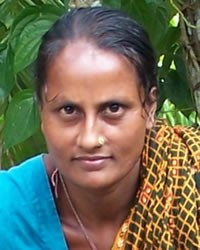

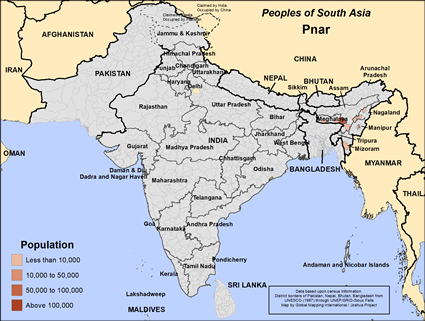
The Pnar, also known as Jaintia, are an indigenous people group primarily residing in the Jaintia Hills of Meghalaya, India, with smaller populations in Assam and neighboring regions. They are part of the larger Khasi-Jaintia ethnolinguistic family, sharing linguistic and cultural ties with the Khasi but maintaining their own distinct identity, language, and traditions. The Pnar trace their ancestry to ancient hill kingdoms, most notably the Jaintia Kingdom, which played a significant role in the region's history before its annexation by the British in the 19th century. Oral traditions, folklore, and clan histories are central to the Pnar sense of identity, preserving stories of migration, kingship, and resilience.
Life among the Pnar is deeply rooted in the lush, rolling hills and fertile valleys of Meghalaya. Most Pnar families are engaged in agriculture, cultivating rice, betel nut, and a variety of fruits and vegetables on terraced fields that contour the hillsides. The region's abundant rainfall and rich soil support not only farming but also the gathering of forest products, which supplement household income and diets. Many Pnar also raise livestock such as pigs, chickens, and cattle, which play important roles in both daily sustenance and ceremonial occasions.
The Pnar are known for their vibrant markets, where men and women alike trade agricultural produce, handicrafts, and textiles. Women play a prominent role in economic life, reflecting the community's matrilineal system, where lineage and inheritance pass through the mother's line. This system shapes family dynamics, with maternal uncles often holding significant influence in household decisions and the upbringing of children.
Homes are typically constructed from bamboo, wood, and thatch, designed to withstand the region's heavy monsoon rains. Villages are close-knit, with neighbors supporting one another in times of need and celebration. Social life is rich with communal activities—folk songs, dances, and storytelling are woven into daily routines and special occasions alike.
Festivals are a highlight of Pnar life, with Behdienkhlam being the most prominent. This annual festival, marked by colorful processions, traditional dances, and the symbolic driving away of evil spirits, draws entire communities together in joyful celebration. Weddings, funerals, and harvest festivals are also observed with elaborate rituals, feasting, and the sharing of traditional rice beer. Through these gatherings, the Pnar reinforce their cultural identity and the bonds that unite them as a people.
Education is increasingly valued, with many families encouraging their children to pursue studies in local schools and, when possible, in larger towns. While some Pnar have migrated to urban centers for work or education, most maintain strong ties to their ancestral villages, returning for major festivals and family events.
The Pnar traditionally practice a form of animism, placing their trust in a pantheon of deities, ancestral spirits, and natural forces. Their religious life centers on rituals and ceremonies conducted by priests and elders, seeking blessings for health, prosperity, and protection from harm. Sacred groves, stones, and rivers are often regarded as dwelling places of spiritual beings, and offerings are made to maintain harmony between the human and spiritual realms. Over time, a significant number of Pnar have embraced Christianity, and churches are present in many villages. Those who follow Christ gather for worship, prayer, and fellowship, while others continue to observe traditional beliefs or blend elements of both. The gospel message is present among the Pnar, offering the hope of salvation and new life in Jesus Christ.
The Pnar face a range of needs, both physical and spiritual. Access to quality healthcare and education remains uneven, especially in remote villages. Economic opportunities are limited, and many families depend on subsistence farming. Spiritually, there is a need for ongoing discipleship and outreach, as well as resources to help believers grow in their faith and share the gospel with others. For those who have not yet heard or accepted the message of Christ, there is a need for culturally sensitive witness and the translation of Scripture into the Pnar language.
Pray for improved healthcare, education, and economic opportunities in Pnar communities.
Ask God to strengthen Pnar believers and equip them to share their faith and disciple others.
Pray for effective translation and distribution of Scripture and Christian resources in the Pnar language.
Request that the Pnar people would experience the peace and hope found in Jesus Christ.
Scripture Prayers for the Pnar in India.
https://www.peoplegroups.org/
https://www.operationworld.org/
| Profile Source: Joshua Project |




