




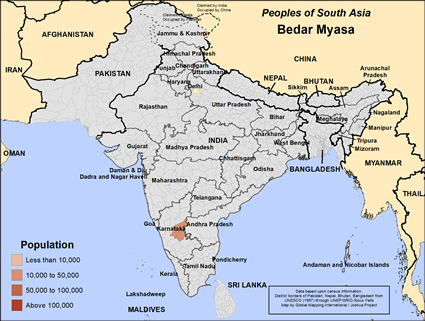
The Myasa Bedar are a people group found in India, primarily in the southern state of Karnataka. Their community traces its roots to migrations from neighboring Andhra Pradesh. The Myasa Bedar speak both Kannada and Telugu, although Kannada serves as their primary language and literacy language. Their bilingual heritage reflects the historical movement of the community between Telugu-speaking and Kannada-speaking regions. Over time, they have become integrated into the social and economic life of Karnataka while maintaining a distinct group identity.
The Myasa Bedar are traditionally agriculturalists, working as cultivators and laborers. Families mainly depend on farming and related rural occupations for their livelihood. Education is increasingly available to their children, and most receive at least primary-level schooling, with some pursuing further studies.
Family and community relationships are important within Myasa Bedar society. Local councils often lead and guide community affairs that assist with handling disputes and promoting the welfare of the group. Marriage customs include unions between certain relatives that are culturally accepted within the community. Divorce and remarriage are permitted, and family property is generally inherited through the male line.
The Myasa Bedar use a mix of both traditional remedies and modern medical care. Most live in villages, and while agriculture remains central to daily life, economic changes in India are gradually creating new opportunities and challenges for younger generations.
The Myasa Bedar are predominantly Hindu, and their religious life is shaped by Hindu beliefs, customs, and festivals that connect them to the broader religious culture of southern India. Family and community celebrations often revolve around traditional Hindu observances and local religious practices.
One distinctive feature of the Myasa Bedar is their practice of burying their dead rather than cremating them, which differs from the custom followed by many Hindu communities. Religious traditions are closely woven into family life, community identity, and the annual cycle of festivals.
Although the Scriptures and Christian resources are available in the languages spoken by the Myasa Bedar, very few have become followers of Jesus Christ. As a result, most members of the community have little personal understanding of the gospel message or of salvation through faith in Christ.
Families involved in agricultural face the uncertainties of weather patterns, crop yields, and economic pressures that affect rural communities across India. Improved educational opportunities, healthcare access, and sustainable livelihoods would contribute to the well-being of Myasa Bedar families and help younger generations prepare for the future.
Greater access to quality employment and vocational training could strengthen economic stability within the community. Continued development of infrastructure and public services would also benefit villages where many Myasa Bedar reside.
Pray that Myasa Bedar families will experience improved health, educational opportunities, and economic stability.
Pray for wisdom and integrity among community leaders as they serve the interests of their people.
Pray that agricultural workers will have favorable conditions for successful harvests and sustainable livelihoods.
Pray that the Lord will raise up compassionate Christian workers who will live among the Myasa Bedar and share the love of Christ through both word and deed.
Pray that the Holy Spirit will open hearts to the gospel and draw many Myasa Bedar to faith in Jesus Christ.
Pray for the emergence of strong local fellowships of believers that will grow in discipleship, worship, and service.
Pray that the Myasa Bedar will become part of God's global mission, sending disciples who will share the good news with others.
Scripture Prayers for the Bedar Myasa in India.
People group research and demographic data compiled from Myasa Bedar community profiles and language resources.
Ethnologue language information for Kannada and Telugu.
People group ministry and research databases concerning the Myasa Bedar of India.
| Profile Source: Joshua Project |




