




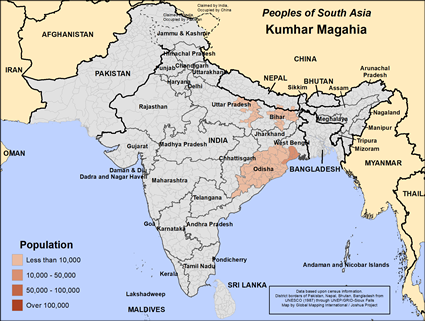
The Magahia Kumhar are a subgroup of the broader Kumhar community of India, a traditional caste historically associated with pottery and clay craftsmanship. They are found mainly in the eastern regions of India, especially in Odisha, Bihar, West Bengal, and nearby areas. Depending on location, they may speak languages such as Maithili, Hindi, Odia, Bengali, or regional dialects. The word "Kumhar" comes from an ancient Sanskrit term meaning "maker of pots," reflecting the community's long connection to pottery and earthenware production.
For generations, the Kumhar communities supplied villages with clay pots, cooking vessels, storage containers, lamps, and ceremonial items used in daily life and religious rituals. The Magahia branch developed its own community identity within this larger artisan tradition. Many Magahia Kumhar families eventually expanded into farming, land cultivation, and small business activities alongside pottery work. Community matters are often overseen through caste councils that help settle disputes and maintain social customs.
Although modernization and industrial manufacturing have reduced demand for traditional pottery in some areas, the cultural identity of the Kumhar people remains closely connected to craftsmanship, family tradition, and village life. Younger generations increasingly pursue education, urban employment, transportation work, and small business opportunities outside traditional occupations.
Many Magahia Kumhar families live in rural villages where farming and agriculture provide a major part of their livelihood. Some still practice pottery and clay work, while others work in local trade, construction, transportation, or small businesses. Families often cultivate their own land for food and income. Traditional artisan skills may still be passed down through generations, especially in communities where pottery remains economically important.
Family structure and community relationships are highly valued. Marriages are commonly arranged with the agreement of both families, and community customs strongly influence social life. The Magahia Kumhar are generally monogamous, and widows or widowers may remarry, though divorce is traditionally discouraged. Sons commonly inherit family property after the death of the father. Caste councils often help regulate disputes and social matters within the community.
Meals often include rice, lentils, vegetables, fish, eggs, and locally available foods. Religious festivals, weddings, seasonal celebrations, and family gatherings remain important parts of daily life. In some areas, access to education has improved, and many younger people seek opportunities beyond traditional village occupations. However, artisan and farming families may still face economic instability, debt, and uncertain employment.
The Magahia Kumhar primarily follow Hinduism and participate in both formal Hindu worship and local folk religious practices. They worship various Hindu gods and goddesses and visit temples to offer prayers, flowers, food, and incense in hopes of receiving blessing, protection, prosperity, and relief from suffering. Belief in karma, rebirth, and the cycle of life and death strongly shapes their worldview.
Like many traditional Hindu communities, the Magahia Kumhar may also combine temple worship with local customs involving ancestral traditions, ritual purity, astrology, and regional deities. Religious festivals such as Holi, Diwali, Navratri, and Rama Navami are important parts of community life. Spiritual identity is often deeply tied to family tradition and caste heritage.
Although some gospel resources exist in languages spoken by the Magahia Kumhar, many still have little understanding of the biblical message of salvation through Jesus Christ. In many cases, Jesus may simply be viewed as another religious figure rather than the crucified and risen Savior who alone reconciles sinners to God. Strong biblical discipleship and faithful local witness remain limited among many communities.
Many Magahia Kumhar families need greater economic stability as traditional artisan work continues to decline in some areas. Farming families can also face challenges related to weather, debt, unstable markets, and limited employment opportunities. Continued access to healthcare, education, vocational training, and sustainable income opportunities would benefit many households.
Spiritually, the Magahia Kumhar need clear access to the gospel in their own languages and cultural setting. Many have never personally heard a biblical explanation of repentance, grace, forgiveness, and eternal life through Jesus Christ. Faithful churches, Scripture distribution, discipleship, and long-term relationship-based ministry are needed among the Magahia Kumhar so entire families and communities can hear and understand the gospel clearly. Existing believers within the broader Kumhar community also need encouragement and spiritual maturity so they can reach neighboring groups with biblical truth.
Pray that the Magahia Kumhar people will hear a clear presentation of the gospel in their own language and place their faith in Jesus Christ.
Pray that God will raise up faithful local believers and church leaders who will disciple Magahia Kumhar families and establish biblically grounded churches among them.
Pray that families struggling with economic hardship, declining artisan work, and limited opportunities will experience practical provision, stability, and hope.
Pray that the Magahia Kumhar people will be adopted through the People Group Adoption program so that ongoing prayer, evangelism, discipleship, and church planting efforts will continue among them.
Scripture Prayers for the Kumhar Magahia in India.
https://en.wikipedia.org/wiki/Kumhar
https://www.sahapedia.org/descendants-prajapati-kumhar-community-potters
https://www.thecitizen.in/india/the-potters-wheel-of-time-353998
https://en.wikipedia.org/wiki/Kumbara
https://www.indpaedia.com/ind/index.php/Kumhar
| Profile Source: Joshua Project |




