




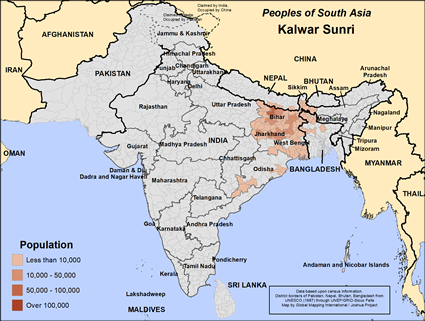
The Sunri Kalwar are a Hindu trading and occupational community found mainly in northern and eastern India, including Bihar, Jharkhand, Uttar Pradesh, and surrounding regions. They primarily speak regional languages such as Hindi, Bhojpuri, Magahi, or related dialects depending on where they live. The Kalwar community has historically been associated with the production and trade of alcoholic beverages, though many families today work in business, shopkeeping, agriculture, transportation, and a wide range of modern occupations. The term "Sunri" is used for a subgroup within the broader Kalwar community structure.
Historically, the Kalwars adapted over generations to changing economic and social conditions. Some community traditions connect them with merchant and trading backgrounds, while others remained tied to village-based occupations. In modern India many Sunri Kalwar families have moved into towns and cities seeking education, business opportunities, and economic advancement. Family reputation, caste identity, and community relationships continue to influence marriage patterns and social life.
The lives of the Sunri Kalwar vary between rural and urban settings. In villages, some families are involved in farming, small trade businesses, transportation work, or local commerce. In cities and towns, many work as shop owners, traders, laborers, office workers, or employees in private businesses. Economic conditions differ widely, with some families achieving financial stability while others continue to struggle with poverty and limited opportunities.
Family life is highly valued, and extended family networks often remain close even after migration to urban areas. Marriages are commonly arranged within the community, and respect for elders continues to shape household relationships. Daily meals often include rice, lentils, flatbreads, vegetables, and locally available foods. Religious festivals, weddings, and community gatherings are important social events that reinforce cultural identity and family ties.
Education has become increasingly important among younger generations, especially for families seeking upward mobility through professional work or business ownership. However, access to quality education and stable employment can still be inconsistent, especially in poorer rural communities.
The Sunri Kalwar primarily follow Hinduism and participate in traditional Hindu religious practices. Worship commonly includes devotion to Hindu gods and goddesses such as Shiva, Vishnu, Durga, and regional deities. Religious observances often include temple worship, festival celebrations, offerings, family rituals, and ceremonies connected to major life events.
Alongside formal Hindu worship, folk religious beliefs may also influence spiritual life. Some families continue practices connected to ancestral reverence, local spirits, astrology, ritual purity, and the seeking of blessing or protection through ceremonies and offerings. Belief in karma and rebirth strongly shapes worldview and moral understanding.
Though some Sunri Kalwar may have encountered Christianity, many have little exposure to the biblical gospel. In many cases, Jesus is viewed simply as another religious figure rather than the unique Son of God and the only Savior from sin. Clear biblical teaching and faithful discipleship remain limited among many communities.
The Sunri Kalwar need continued access to quality education, healthcare, vocational opportunities, and economic stability. Rural communities may face limited infrastructure, inconsistent employment, and inadequate medical care, while urban families often deal with financial pressure, overcrowding, and social change.
Spiritually, the greatest need is for clear gospel witness rooted in Scripture and communicated in culturally understandable ways. Many Sunri Kalwar families have never heard a clear explanation of salvation by grace through faith in Jesus Christ. There is a need for faithful local churches, discipleship, Scripture distribution, and believers willing to build long-term relationships within the community. Christians from nearby language groups who already know Christ can also play an important role in sharing the gospel with the Sunri Kalwar.
Pray that the Sunri Kalwar people will hear and understand the gospel clearly in their own language and place their trust in Jesus Christ.
Pray that God will raise up faithful believers and church leaders who will disciple Sunri Kalwar families and establish strong biblical churches among them.
Pray that families facing poverty, educational barriers, or economic uncertainty will receive practical help, opportunity, and hope.
Pray that the Sunri Kalwar people will be adopted through the People Group Adoption program so that ongoing prayer, evangelism, discipleship, and church planting efforts will continue among them.
Scripture Prayers for the Kalwar Sunri in India.
https://en.wikipedia.org/wiki/Kalwar
https://www.india9.com/i9show/Kalwar-Community-46718.htm
https://peoplegroups.org/explore/GroupDetails.aspx?peid=41639
https://en.wikipedia.org/wiki/Caste_system_in_India
| Profile Source: Joshua Project |




